If you want rugged, compact off-road capability with easier towing and better fuel economy, a slide-in camper fits truck beds. It offers basic sleeping and cooking in a lightweight design.
For spacious interiors, full kitchens, bathrooms, and extensive amenities suited for longer trips, travel trailers are larger. They require heavier tow vehicles and more skill to maneuver.
They also demand higher maintenance and storage costs. Keep exploring to understand which option best matches your camping style and needs.
Key Takeaways
- Slide-in campers are compact, lightweight, and designed for rugged, off-grid use with basic sleeping and cooking amenities.
- Travel trailers offer larger interiors, full kitchens, bathrooms, and climate control for extended living and more passengers.
- Slide-in campers improve fuel economy and maneuverability due to reduced weight and smaller size compared to heavier, bulkier travel trailers.
- Travel trailers require heavier tow vehicles, complex hitch setups, and more skill for maneuvering, especially in tight or rough terrain.
- Slide-in campers have lower purchase, maintenance, and storage costs, while travel trailers provide greater comfort and convenience for long trips.
Travel Trailer vs Slide in Camper: Side-by-Side Comparison
| Feature | Slide-In Camper | Travel Trailer |
|---|---|---|
| Size | Compact and truck-bed mounted | Larger and tow-behind design |
| Weight | Lighter and easier on the vehicle | Heavier and needs stronger towing capacity |
| Maneuverability | Easier in tight roads and rough terrain | Harder to reverse and park in small spaces |
| Comfort | Basic essentials for simple travel | More comfort, room, and living space |
| Amenities | Minimal setup, often small kitchen and sleeping area | Full kitchens, bathrooms, AC, and more storage |
| Off-Road Use | Better suited for rugged and off-grid trips | Best for campgrounds and paved travel routes |
| Fuel Efficiency | Better due to lower weight | Lower because of towing drag and size |
| Cost | Usually more affordable upfront and to maintain | Typically more expensive to buy and maintain |
| Setup Style | Truck remains usable after unloading | Requires hitching, leveling, and stabilization |
Key Factors for Choosing Slide-In Campers vs Travel Trailers

When deciding between slide-in campers and travel trailers, you need to take into account several key factors that directly impact your towing capabilities, camping style, and comfort requirements.
Slide-in campers attach securely to your truck bed, providing a compact, lightweight option that improves fuel economy and ease of maneuvering. They suit rugged terrain and off-grid adventures with self-contained water and power systems.
Slide-in campers offer lightweight, compact design perfect for off-grid adventures and improved fuel efficiency.
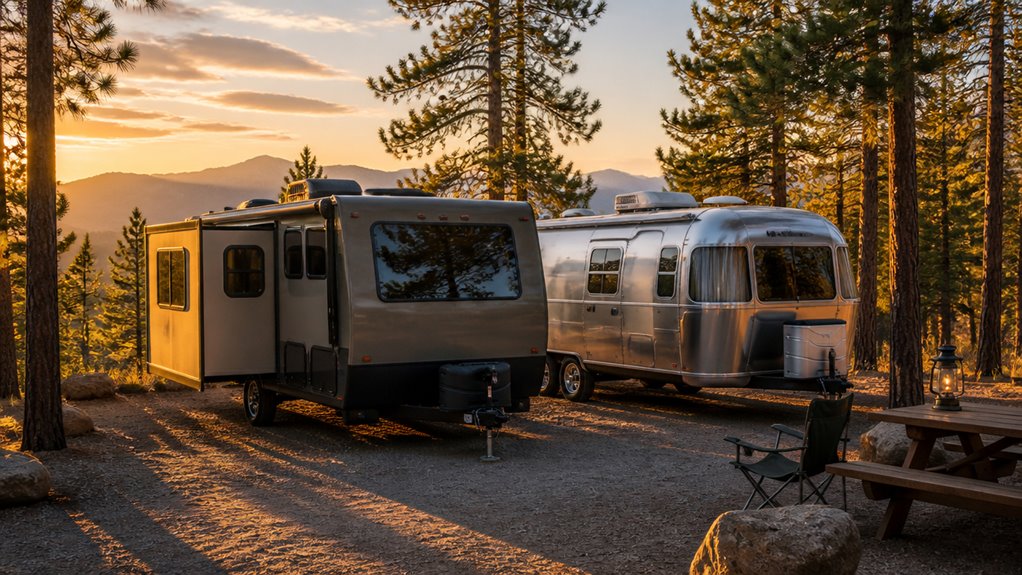
Travel trailers, by contrast, demand heavier tow vehicles and are best for extended stays at established sites. They offer full kitchens, bathrooms, and climate control.
You’ll also want to ponder setup convenience: slide-in campers let you use your truck independently once parked, while travel trailers require more space and care to hitch and stabilize.
Balancing these factors will help you select the camper that aligns precisely with your needs. Additionally, using the right RV stabilizer jacks can significantly enhance the stability and comfort of your travel trailer setup.
Size and Weight Differences Between Slide-In Campers and Travel Trailers
You’ll notice that slide-in campers are usually smaller and lighter than travel trailers, which makes them a breeze to tow and maneuver.
Because they weigh less, they put less strain on your vehicle. This not only improves fuel efficiency but also opens up your options for tow vehicles.
On the flip side, travel trailers can stretch up to 40 feet in length!
They’re significantly bigger and heavier, so you’ll need a more robust towing setup to handle that size and mass. It’s definitely something to keep in mind when you’re deciding which option fits your needs best.
For those using a Toyota Tacoma, considering bed cover compatibility can also impact your cargo protection and vehicle setup.
Camper Size Comparison
Slide-in campers generally measure markedly smaller and weigh less than travel trailers, making them easier to tow and maneuver. Typically, slide-in campers fit within your truck bed, ranging from 8 to 16 feet in length, with a lighter frame designed for rugged terrain.
In contrast, travel trailers can extend up to 40 feet, demanding more substantial tow vehicles. Their larger dimensions accommodate spacious interiors, including full kitchens and bathrooms, but add considerable bulk.
When comparing height and width, slide-in campers maintain a compact profile, improving clearance on narrow roads. You’ll notice travel trailers offer increased cargo and living space but sacrifice agility.
Understanding these size differences helps you select a camper that aligns with your vehicle capabilities and travel style without compromising safety or convenience. Additionally, choosing the right truck bed size is essential for compatibility and ease of use with slide-in campers.
Weight Impact on Towing
The differences in size between slide-in campers and travel trailers directly influence their weight, which markedly affects towing requirements.
Slide-in campers are smaller and lighter, typically designed for rugged terrain. This means you can tow them with lighter vehicles and experience better fuel economy.
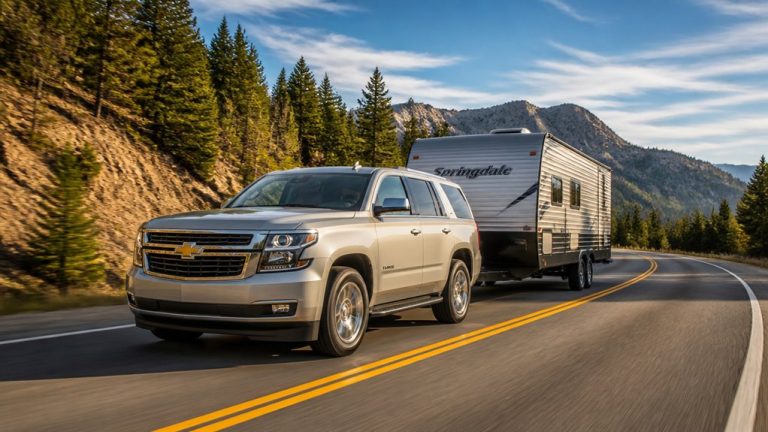
In contrast, travel trailers can extend up to 40 feet and weigh substantially more. This demands heavier-duty tow vehicles with higher towing capacity.
This weight disparity impacts not only the type of vehicle you need but also fuel consumption and handling.
When towing a travel trailer, you must account for increased braking distances and reduced maneuverability.
Choosing a slide-in camper eases towing strain, while travel trailers offer more space at the cost of requiring stronger tow setups and careful driving considerations.
Additionally, selecting the right weight and size of your cover can help protect your RV during transport and storage.
Maneuverability and Towing for Slide-In Campers vs Travel Trailers
Although both slide-in campers and travel trailers require a proper hitch and towing package, their maneuverability differs markedly.
When towing, slide-in campers offer greater agility due to their smaller size and lighter weight. This makes them ideal for handling tight roads and backroads.
Travel trailers, often larger and heavier, demand more skill to maneuver, especially in urban settings or crowded campgrounds.
Consider these key points:
- Slide-in campers attach directly to your truck bed or hitch, allowing easier vehicle use after setup.
- Travel trailers rely on bumper hitches or fifth wheels, complicating parking and reversing.
- The compact design of slide-in campers reduces sway and improves towing stability.
- Travel trailers require heavier tow vehicles and more caution due to their length and weight.
Choose based on your towing comfort and travel routes.
For optimal safety and control, selecting a hitch with proper weight distribution and sway control is essential when towing travel trailers.
Off-Road and Terrain Capabilities of Slide-In Campers vs Travel Trailers
When you venture off established roads, you’ll find that campers built for rugged terrain outperform travel trailers in durability and mobility.
Slide-in campers are engineered with reinforced frames and higher ground clearance, allowing you to navigate forest service roads and uneven trails with greater ease.
Slide-in campers feature reinforced frames and higher clearance for easier travel on rugged, uneven trails.
Their compact size and lighter weight reduce stress on your tow vehicle, improving traction and control on loose or rocky surfaces.
Travel trailers, by contrast, are designed primarily for established campsites, lacking the structural robustness for rough terrain.
Their larger size and lower clearance increase the risk of damage when off-road.
Additionally, slide-in campers often include self-contained systems for water and electricity, enabling you to camp independently off-grid.
Travel trailers typically rely on external hookups.
This makes slide-in campers more versatile for off-road adventures.
For those using vehicles like the RAM 1500 to tow, having access to live data monitoring tools can help ensure your vehicle performs optimally on challenging terrain.
Amenities and Comfort: Comparing Campers and Travel Trailers
Off-road capabilities influence how you plan your trips, but comfort and amenities define your experience once you arrive. When weighing slide-in campers against travel trailers, consider how each supports your lifestyle on the road.
- Slide-in campers prioritize essentials: basic sleeping quarters, minimal kitchen setups, and compact bathrooms, focusing on lightweight utility.
- Travel trailers offer full-range amenities like full kitchens, bathrooms, air conditioning, and heating systems, enhancing long-term comfort.
- You’ll find travel trailers usually accommodate more people, sleeping four or more, while campers suit smaller groups.
- Power systems in travel trailers are robust, supporting multiple appliances, whereas campers maintain simpler, self-contained solutions for off-grid use.
Choosing between them depends on whether you want efficient, rugged simplicity or more extensive living conveniences. Additionally, protecting your RV with a custom-fit, breathable cover during winter can help preserve its condition and reduce maintenance costs.
Cost and Maintenance Differences Between Slide-In Campers and Travel Trailers
When it comes to pricing, slide-in campers usually have the edge. They’re generally more affordable upfront compared to travel trailers, mainly because they’re smaller and have simpler features. So, if you’re looking to save some cash right off the bat, slide-in campers might be the way to go.
Now, let’s talk maintenance. With slide-in campers, things tend to be a bit more straightforward. You’ll often find lower insurance costs and storage fees, which is a nice perk. On the flip side, travel trailers can require a bit more upkeep, thanks to their larger systems and added amenities. Additionally, regular maintenance such as waxing is essential to protect the exterior and maintain value, especially for outdoor-stored travel trailers exposed to environmental factors.
Price Comparison Overview
Although slide-in campers generally cost less upfront, understanding the full price comparison requires examining maintenance, insurance, and operational expenses.
When deciding between a slide-in camper and a travel trailer, consider these critical cost factors:
- Initial Purchase Price: Slide-in campers are typically more affordable due to smaller size and fewer amenities.
- Insurance Premiums: Campers usually incur lower insurance costs because of lighter weight and simpler design.
- Fuel Efficiency: Slide-in campers improve fuel economy since they add less towing weight compared to larger travel trailers.
- Storage and Campsite Fees: Smaller size reduces storage costs and campsite fees, benefiting your long-term budget.
Additionally, selecting the appropriate towing capacity of your hitch is essential to ensure safe and efficient transport of your camper or trailer.
Maintenance And Upkeep
Because slide-in campers are smaller and simpler in design, they generally demand less maintenance and upkeep than travel trailers. You’ll spend less time on repairs and lower costs on parts and servicing.
Travel trailers, with their complex systems and larger size, require more frequent inspections and maintenance, especially for plumbing, electrical, and exterior seals.
| Maintenance Aspect | Slide-In Camper | Travel Trailer |
|---|---|---|
| Exterior Seals | Inspect annually | Inspect bi-annually |
| Electrical Systems | Basic checks | Complex systems, frequent checks |
| Plumbing | Minimal maintenance | Extensive system upkeep |
| Cost (Annual Avg.) | Lower ($200-$400) | Higher ($500-$900) |
You’ll find slide-in campers more cost-effective and easier to maintain. Travel trailers need more attention to preserve their amenities and larger structure. It is also important to regularly inspect seals to prevent damage and maintain airtightness, especially for travel trailers with more extensive exterior surfaces.
Storage, Usage, and Seasonal Convenience for Slide-In Campers vs Travel Trailers
When comparing storage and usage, slide-in campers offer a compact design that simplifies off-season storage and reduces space requirements.
Their smaller footprint means you can store them in standard garages or tighter spaces.
Travel trailers, while larger, provide increased cargo capacity and extended living amenities, ideal for longer trips.
Travel trailers offer spacious living and ample cargo capacity, perfect for extended adventures and long trips.
Consider these points:
- Slide-in campers primarily facilitate sleeping and basic cooking, encouraging outdoor activity.
- Travel trailers support extended living with full kitchens, bathrooms, and storage.
- Campers’ compact size allows easier transport and seasonal storage.
- Trailers require larger storage areas but offer enhanced convenience during use.
You’ll find slide-in campers more seasonally convenient for quick getaways.
Travel trailers excel in long-term comfort and storage capacity.
Frequently Asked Questions
How Do Slide-In Campers Affect My Vehicle’s Resale Value?
Using a slide-in camper generally has minimal impact on your vehicle’s resale value, provided you maintain it well.
Since campers are lighter and designed for rugged use, they put less strain on your truck’s frame and suspension compared to heavier trailers.
You should regularly inspect for any mounting damage or wear.
Proper installation and removal guarantee your vehicle stays in good condition, preserving its resale appeal and avoiding costly repairs down the line.
Are Slide-In Campers Compatible With All Truck Beds?
No, slide-in campers aren’t compatible with all truck beds.
You need to guarantee your truck’s bed size matches the camper’s dimensions. Typically, campers fit standard short, standard, or long beds.
Payload capacity is vital too; your truck must support the camper’s weight safely.
Additionally, the truck bed should have proper tie-down points for secure installation.
Always check manufacturer specifications to confirm compatibility before purchase or installation.
Can Travel Trailers Be Customized After Purchase?
Yes, you can customize travel trailers after purchase. Many owners upgrade interiors, appliances, or add solar panels and advanced electronics.
You might install additional storage, replace furniture, or enhance insulation for comfort. However, modifications should consider structural integrity and warranty conditions.
Since travel trailers have larger, more complex systems than campers, you’ll want to plan carefully. Consulting professionals can ensure your customizations improve functionality without compromising safety or resale value.
What Are the Insurance Requirements for Slide-In Campers?
You’ll need to insure your slide-in camper under a recreational vehicle policy or an endorsement on your auto insurance.
Coverage typically includes liability, all-risk, and collision, protecting against damage, theft, or accidents.
Requirements vary by state and insurer, so check local laws and your policy options.
Since campers are lighter and smaller, insurance premiums might be lower than for travel trailers.
However, you still want adequate coverage tailored to your usage and storage conditions.
How Do Weather Conditions Impact Camper and Trailer Durability?
Weather conditions impact durability by exposing your camper or trailer to moisture, UV rays, and temperature fluctuations.
Prolonged sun weakens exterior materials, while rain and snow cause rust, rot, and mold if seals fail.
Freeze-thaw cycles can crack surfaces. You’ll want to maintain seals, use protective coatings, and store your unit under cover in harsh climates.
Slide-in campers, built ruggedly, often withstand rough conditions better than larger trailers.
Make the Smart RV Decision Today
When choosing between a slide-in camper and a travel trailer, consider that nearly 60% of RV owners prefer travel trailers for their ease of use and spacious interiors.
You’ll appreciate how slide-in campers offer compact convenience and better maneuverability.
Travel trailers provide more amenities and stability.
By weighing size, towing, comfort, and maintenance, you can select the option that best matches your adventure style and vehicle capacity for efficient, enjoyable travel.