If you want to reduce paint abrasion and improve cleaning efficiency, foam cannons are worth considering.
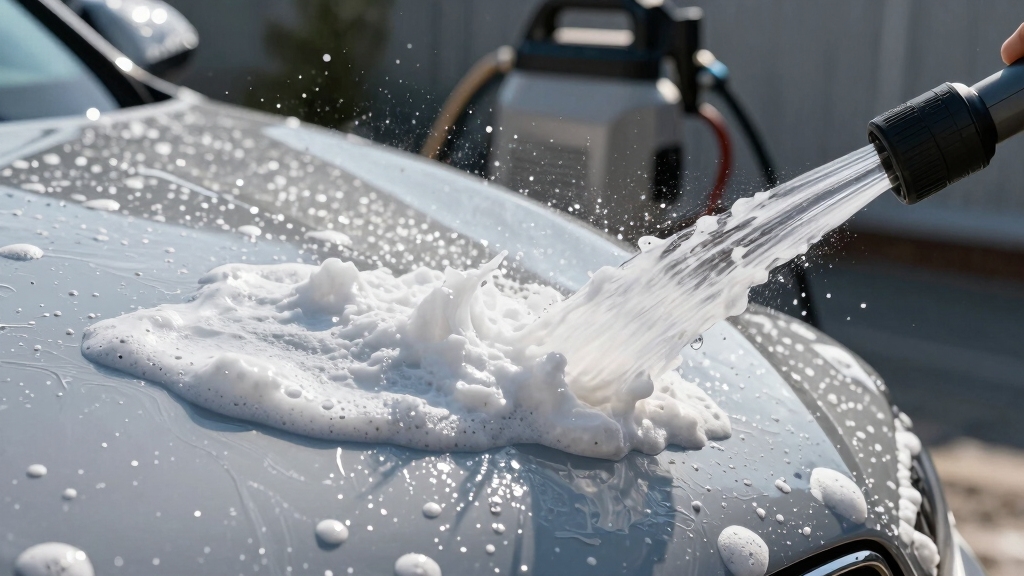
They apply thick, clinging suds that loosen dirt with less scrubbing, lowering scratch risks and enhancing paint safety.
Foam cannons speed up wash time and use water more efficiently than standard hoses.
However, they need proper dilution, compatible pressure washers, and specific detergents.
Understanding their setup, ideal uses, and maintenance helps you optimize performance and value.
Key Takeaways
- Foam cannons create thick, clingy foam that loosens dirt and reduces the need for aggressive scrubbing, protecting paint from scratches.
- Proper foam application extends detergent dwell time, enhancing cleaning effectiveness and reducing manual labor during washes.
- Using foam cannons streamlines the washing process, saving time and water compared to traditional hose or hand-washing methods.
- Correct dilution and foam quality are essential to avoid residue, chemical etching, and maintain paint safety during washing.
- Foam cannons are not standalone cleaners; heavily soiled areas may still require targeted mechanical action for thorough cleaning.
Comparing Foam Cannons to Traditional Washing Methods

While traditional hand-washing relies heavily on manual scrubbing, foam cannons enhance efficiency by applying thick, clinging foam that loosens dirt and suspends particles before any physical contact. This pre-rinse foam reduces active scrubbing time, especially for light to medium soils, by extending chemical dwell time compared to garden-hose soap.
Though setup and teardown for pressure-washer–mounted foam cannons add some time, frequent users gain net time savings. Using a foam cannon with a pH-balanced soap ensures safe and effective cleaning while maintaining the paint’s deep gloss.
Foam cannons boost cleaning efficiency by applying thick foam that breaks down dirt before scrubbing begins.
Foam detergents encapsulate contaminants, improving removal during rinsing and minimizing abrasive rubbing during mitt use. Additionally, these cleaners effectively remove dirt that water alone cannot eliminate, contributing to a more thorough cleaning process. However, heavily soiled areas like wheel wells may still require targeted mechanical action.
Proper foam quality, chemical concentration, and pressure flow are critical; inadequate foam can leave residues needing follow-up cleaning. Overall, foam cannons streamline workflows, cutting total wash time while preserving effective manual cleaning for stubborn deposits.
Impact on Paint Safety and Scratch Prevention
Using foam lubrication can really enhance your car washing experience. It works wonders by cushioning dirt particles, which helps to reduce any abrasion during the washing process.
Plus, when you ensure that your soap is properly diluted, you maintain the right pH balance. This is super important because it prevents any potential paint damage and keeps residue from building up. Proper water flow and detergents lubricate surfaces, reducing abrasion during cleaning, which is essential for paint longevity.
And let’s not forget about the benefits of foam cannons! By minimizing the need for mechanical scrubbing, they play a big role in protecting your paint from scratches and swirl marks. Additionally, foam cannons soften contaminants effectively, reducing the effort needed to remove dirt.
Foam Lubrication Benefits
Frequently, foam cannons provide a critical layer of lubrication that markedly enhances paint safety during washing.
This thick foam creates a slick surface, allowing your wash mitt to glide effortlessly. This minimizes abrasion and reduces swirl marks. It is important to use ample lubrication during washing to minimize micro-scratches and protect the paint surface.
It encapsulates and lifts dirt before contact, preventing grime from scratching the paint.
The prolonged foam dwell time further softens contaminants, ensuring safer cleaning.
Foam cannons are designed to produce super thick foam, which maximizes these lubrication benefits.
This lubrication is especially essential for soft or recently corrected paint, offering uniform protection and lowering the risk of new damage.
| Benefit | Description |
|---|---|
| Lubrication | Creates slick surface for mitt glide |
| Dirt Encapsulation | Lifts and isolates dirt to prevent scratches |
| Scratch Reduction | Minimizes swirl marks by reducing friction |
| Dwell Time | Extends foam contact to loosen contaminants |
| Paint Protection | Safeguards delicate or corrected paint surfaces |
Proper Dilution Importance
Maintaining the right dilution ratio directly influences the foam cannon’s ability to protect your paint from scratches. Using the proper mix guarantees the foam clings effectively, lubricates surfaces, and minimizes friction during washing.
For example, many products recommend a foam cannon dilution of 4 parts water to 1 part product, ensuring optimal foam generation and cleaning power Foam Cannon typical soap ratio. Additionally, selecting pH-safe dilutions is crucial to avoid damaging sensitive finishes during the cleaning process.
Over-concentrating soap reduces cleaning power and increases scratch risk by failing to loosen dirt properly. Follow label-recommended ratios like 10:1 for general use or 4:1 for ceramic coatings to maintain pH balance and paint safety.
Avoid generic soaps that strip protective layers. Proper dilution balances cleaning strength and lubrication.
Excess soap wastes product and lowers foam effectiveness. pH-safe dilutions protect chrome, matte, and coated finishes. Correct foam adhesion reduces abrasive contact with paint. Evenly distributed foam ensures safe rinsing and dirt removal.
Minimizing Wash Abrasion
When you use a foam cannon for pre-washing, it markedly reduces wash abrasion by encapsulating and lifting dirt particles away from your vehicle’s paint surface.
The thick foam clings longer, loosening contaminants and adding essential lubrication that lets your wash mitt glide smoothly. This minimizes friction and prevents micro-scratches. The foam cannon uses a strainer and air intake valve to create a thick soapy foam that clings effectively to surfaces.
This lubrication is critical for safer agitation, especially on new or soft paint, reducing swirl marks and light scratches.
The foam’s encapsulation prevents cross-contamination by isolating dirt, so you avoid dragging abrasive particles across panels.
Extended dwell time breaks down heavy soils, requiring less scrubbing force during rinsing.
Compared to traditional two-bucket or hand washing methods, foam cannon pre-washing consistently lowers abrasion risk.
This enhances paint safety and preserves finish integrity, key when preparing surfaces before ceramic coating.
Efficiency in Time and Water Usage
You’ll notice that foam cannons really speed up the soap application process compared to traditional methods. This means you can cut down your prep time quite a bit! For example, applying foam with a 1.2 GPM unit can be done in about 20 seconds, demonstrating impressive time efficiency.
Plus, they deliver foam in a controlled way, which actually helps reduce water usage compared to standard hoses. Foam cannons often use low-pressure soap delivery to ensure even coverage and effective cleaning, which contributes to water conservation. Isn’t that great for conservation efforts?
And there’s more! The thick foam clings to surfaces longer, which can help you shorten your rinse time.
You won’t have to compromise on cleanliness either.
Faster Soap Application
Applying soap with a foam cannon drastically speeds up your wash process by creating a thick, clingy layer of detergent that loosens grime and reduces the need for aggressive scrubbing. This pre-application allows surfactants to emulsify oils during dwell time, cutting down your active cleaning phase notably.
The foam’s even coverage helps you spot remaining dirt quickly, so you only scrub where necessary, avoiding redundant effort. Covers large areas uniformly in one pass, minimizing application time while also reducing water usage through efficient coverage.
Enables simultaneous tasks during foam dwell, optimizing workflow. Many foam cannons feature adjustable foam density to match soil levels, preventing overuse.
Adjustable foam density matches soil levels, preventing overuse. Specialized foam formulas enhance first-pass soil removal efficiency. Many specialty soaps, such as Chemical Guys Honeydew Snow Foam, are engineered specifically to create thick foam that improves cleaning power.
Warm-water dilution accelerates soil breakdown and shortens dwell time. This precision translates to a faster, more efficient soap application with less manual labor.
Water Conservation Benefits
Although water conservation often takes a backseat during routine car washes, using a foam cannon paired with a pressure washer markedly enhances water efficiency.
Pressure washers operate at 2–5 gallons per minute (gpm), appreciably lower than the typical 10 gpm garden hose flow.
The foam cannon converts this water into dense foam, increasing soap dwell time and coverage, which reduces the need for repeated scrubbing and rinsing.
This foam blanket adheres to surfaces, loosening soils effectively with less water.
By replacing continuous high-flow rinsing with low-flow foaming, you can cut water use by 50–80 gallons per wash compared to an unrestricted hose.
Foam cannons specifically designed for pressure washers maximize foam retention, optimizing water and detergent use for sustainable, efficient car cleaning. Using eco-friendly formulations in detergents further supports environmental safety and effective cleaning.
Additionally, regulatory emphasis on water conservation and eco-friendly cleaning agents is driving the uptake of foam cannons for their efficient water and detergent use.
Rinse Time Considerations
Maximizing water efficiency with a foam cannon also hinges on managing rinse times effectively. You need to balance foam dwell time and rinse duration to optimize cleaning without wasting water or time.
The right dilution ratio, such as 1:16 for budget foam cannons or 1:32 for professional setups, ensures consistent foam quality that cleans safely and efficiently. Selecting the appropriate equipment with high flow rates (GPM) can further enhance rinse efficiency and reduce water usage.
Consider these critical factors:
Foam dwell time (1–5 minutes) must match soap strength and contamination level to minimize manual scrubbing and rinse cycles. Higher pressure washer flow rates (GPM) reduce rinse time; lower GPM units require longer rinsing or adjusted spray technique.
Proper soap dilution (1:10 to 1:32) guarantees foam longevity without sticky residues that increase rinse duration. Water quality impacts foam breakdown; softened water shortens rinse and reduces spotting. Using filtered or softened water can significantly improve foam stability and reduce the need for extended rinsing.
Avoid overlong dwell (>10 minutes) in heat to prevent drying foam, which demands extra rinsing. Optimizing these variables helps you save water and time during the rinse phase.
Cost Considerations and Equipment Compatibility
When choosing a foam cannon, you need to balance cost with equipment compatibility to guarantee peak performance. Foam cannons range from budget $20 models to premium $140 units, with diminishing returns beyond $60 for casual users.
The most popular models on e-commerce platforms balance price, functionality, durability, offering great value for typical consumers. Many outdoor tools emphasize portability and ease of use, which can also apply to foam cannon selection.
Compatibility hinges on your pressure washer’s 800–3500 psi range and the correct fittings. Some models offer quick-connects for easier setup, while others require specific adapters. Hose-powered foam guns avoid pressure washer reliance but may sacrifice foam quality.
| Price Range | Performance | Compatibility |
|---|---|---|
| $20–$40 | Basic foam, adequate wash | Standard fittings, lower PSI |
| $50–$85 | Better foam control | Quick-connect, adjustable nozzles |
| $90–$140+ | Premium durability, smooth foam | Specialized fittings, high PSI |
Choose wisely to optimize cost and gear synergy.
Ideal Scenarios for Foam Cannon Use
Since foam cannons create a thick layer of foam that encapsulates dirt and contaminants, you can markedly reduce abrasive contact during washing. This protects your vehicle’s paint from scratches. The patented (#10,562,049) two-stage nozzle allows you to adjust the spray pattern between vertical and horizontal, providing spray pattern versatility to suit different vehicle shapes and sizes.
Foam cannons form a protective foam barrier that lifts dirt, minimizing paint scratches during washing.
They excel in scenarios requiring gentle yet effective pre-wash treatment and rapid coverage. You’ll find foam cannons ideal when:
- Washing daily-driven or lightly soiled vehicles to loosen road film efficiently.
- Cleaning larger vehicles (RVs, trucks) where broad surface coverage saves time.
- Detailing motorcycles or bicycles with complex shapes needing minimal scrubbing.
- Pre-treating boats to break down salt and organic films before rinsing.
- Applying detergents to porous or vertical surfaces (siding, fences) to enhance dwell time.
In these cases, foam cannons optimize workflow while preserving delicate finishes and reducing labor intensity. Additionally, using foam cannons with appropriate portable water heaters can improve detergent effectiveness by maintaining optimal cleaning temperatures.
Limitations and Potential Drawbacks
Although foam cannons offer efficient pre-wash coverage, they come with several limitations you should consider before investing.
First, their performance depends on a compatible pressure washer with sufficient flow (1.5–2.0 GPM) and pressure (1,000–1,500+ PSI); low-power units yield weak foam. The price range for pressure washers can vary widely, typically between $100–$900, which may impact the overall cost of using a foam cannon.
You’ll also face challenges with fittings and adapters due to varying thread standards, risking leaks or poor spray patterns.
Additionally, foam cannons require specialized detergents, increasing ongoing costs.
From an environmental perspective, higher water use and potential runoff restrictions may limit use, especially in drought-prone or regulated areas.
Paint safety risks include chemical etching from improper dwell times and abrasive residue trapping under foam, which can cause swirl marks if rinsing isn’t thorough.
Finally, foam cannons aren’t standalone cleaners and demand proper maintenance to avoid clogging and degradation.
Tips for Setup and Optimal Performance

To achieve peak foam cannon performance, you need to guarantee proper setup and precise adjustments tailored to your pressure washer and cleaning task.
Begin by securely attaching the foam cannon to your pressure washer’s gun, ensuring the quarter-inch quick connection plug is firmly in place and the canister is hand-tightened without over-tightening.
Prepare your solution by filling the canister about 75% with warm water and adding 1-2 ounces of pH-balanced snow foam soap, then swirl gently to mix. It is important to use car wash soaps formulated for foam cannon use to generate thick, clingy suds that adhere well to surfaces.
Adjust the soap control knob and the nozzle to fine-tune foam thickness and spray pattern. For best results:
Use a pressure washer with minimum 1.5 GPM and 1100 PSI.
Start spraying from the top, moving downward.
Allow 3-5 minutes foam dwell time.
Work in shaded areas to prevent premature drying.
Rotate nozzle for wide or concentrated spray coverage.
Maintenance and Troubleshooting Strategies
After setting up your foam cannon correctly and achieving peak foam application, maintaining the equipment guarantees consistent performance and longevity.
Flush the canister and internal passages with clean water immediately after use to prevent soap buildup and watery foam. Run water through the nozzle and fan chamber for 30–120 seconds, then disassemble and air-dry removable parts to avoid corrosion.
Using a non-opaque bottle with volume measurements helps ensure proper soap dilution and prevents leftover residue that can affect performance.
Inspect filters every 25–50 uses; replace clogged ones promptly to restore flow. Use deionized water to minimize scale, and soak parts in mild acid solutions periodically to dissolve deposits.
Check O-rings and seals for damage each session, lubricate them lightly with approved lubricants, and avoid over-tightening threads to prevent stripping.
Keep spare parts on hand and log usage intervals for timely replacements, ensuring your foam cannon remains reliable and efficient.
Frequently Asked Questions
Can Foam Cannons Be Used With Cold Water Effectively?
Yes, you can use foam cannons effectively with cold water, but expect weaker foam density compared to warm water.
To optimize performance, increase soap concentration (around 3-3.5 oz per 32 oz bottle) and guarantee your pressure washer meets minimum specs (1.3-5.3 GPM, 870-3190 PSI).
Adjustable foam settings help compensate for cold water’s limitations, and distilled cold water prevents spotting while dissolving chemicals adequately.
With proper adjustments, cold water usage is viable.
Do Foam Cannons Work on Surfaces Other Than Vehicles?
Yes, foam cannons work on surfaces beyond vehicles: they cling to siding, concrete, and outdoor furniture, increasing detergent dwell time.
They soften grime on painted metal, lift pollen from plastics, and pre-treat fabrics. However, you’ll need to adjust detergent type and concentration for porous materials and delicate finishes.
Their effectiveness depends on foam density, dwell time, and rinsing method. Proper chemistry and technique guarantee thorough cleaning without damage across various surfaces.
How Does Water Hardness Affect Foam Cannon Performance?
Water hardness negatively impacts your foam cannon’s performance by reducing foam thickness and stability.
Calcium and magnesium ions bind with your surfactants, lowering bubble formation and causing larger, weaker bubbles that collapse faster.
This means your foam clings less and breaks down quicker, reducing cleaning effectiveness.
You’ll need higher detergent concentrations, water-softening additives, or treated water to restore peak foam quality and maintain consistent wash results.
Are Foam Cannons Safe for Use on Motorcycle Paint?
When it comes to motorcycle paint, foam cannons are generally safe if you play your cards right.
Use pH-neutral automotive soaps and stick to manufacturer-recommended PSI and GPM limits to avoid clearcoat damage. Pre-rinse to remove grit, follow with a two-bucket wash, and avoid letting foam dry in direct sun.
Protect sensitive parts from high-pressure spray. Done correctly, foam cannons minimize abrasion while providing efficient cleaning without risking your bike’s finish.
Can Foam Cannons Be Used Indoors or in Enclosed Spaces?
You can use foam cannons indoors, but you need strict controls.
Make certain excellent ventilation to prevent aerosol and chemical buildup.
Manage foam runoff with proper drainage or absorbent mats to avoid slips and plumbing issues.
Use PPE like gloves, eye, and respiratory protection due to high-pH chemicals.
Also, control spray patterns to minimize overspray.
Without these precautions, indoor use poses significant safety and performance challenges.
Next Wash Challenge: Try a Foam Cannon Pre-Wash Correctly
Foam cannons can reduce water usage by up to 50% compared to traditional washing, making them both efficient and eco-friendly.
You’ll protect your paint better by minimizing direct contact, reducing scratch risks markedly.
While initial costs and compatibility matter, the time saved and improved cleaning quality often justify the investment.
With proper setup and maintenance, foam cannons offer a precise, safe, and efficient alternative to conventional washing methods.