
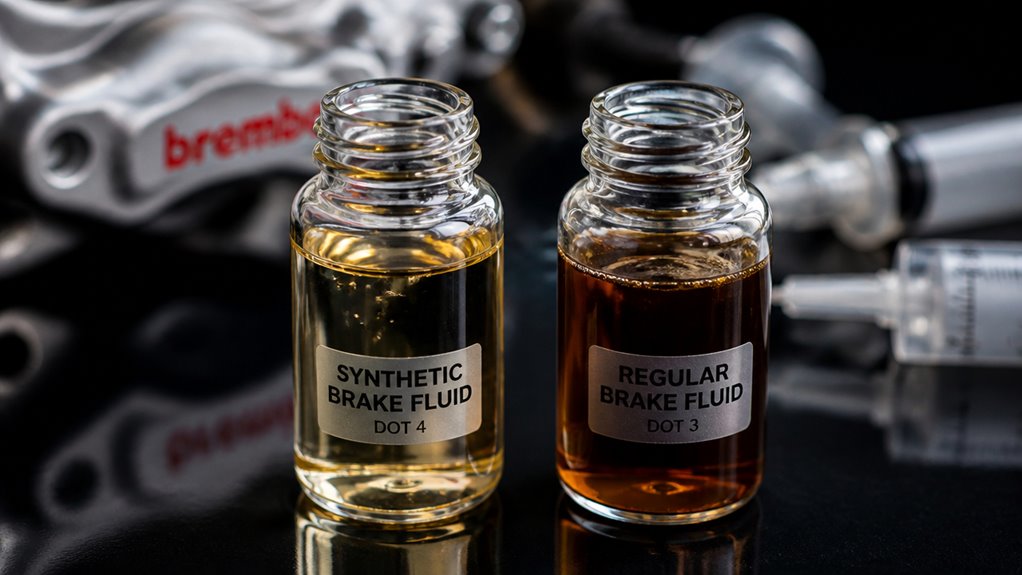
You should focus on your vehicle’s required DOT brake fluid specification rather than the “synthetic” label. Both synthetic and regular fluids often share the same glycol-based chemistry.
The critical difference lies in certified boiling points and system compatibility, not marketing terms. Using fluid that matches your DOT rating guarantees peak performance, chemical compatibility, and brake system protection.
Mixing incompatible types, especially DOT 5 silicone fluid, risks damage. Understanding fluid chemistry, boiling points, and maintenance will clarify their real impact on braking.

- Mixes well with conventional fluids
- Low-moisture formula provides excellent vapor lock protection
- Ideal for hydraulic and disc brakes


- Synthetic quality brake fluid
- Contains special ingredients to guard against vapor lock and moisture absorption
- Exceeds requirements for both DOT 3 and DOT 4 brake fluids
Key Takeaways
- “Synthetic” brake fluid often refers to glycol-ether-based DOT 3, 4, or 5.1 fluids, similar chemically to many regular fluids.
- Regular and synthetic brake fluids share the same base chemistry; “synthetic” is mainly a marketing term without distinct chemical differences.
- DOT 5 silicone-based fluid is chemically different and incompatible with glycol-based fluids labeled as synthetic or regular.
- Performance and compatibility depend on DOT specifications and chemical composition, not the synthetic label.
- Proper fluid maintenance and matching DOT rating ensure braking efficiency, regardless of synthetic or regular classification.
How to Choose and Maintain Brake Fluid for Your Car?

Choosing and maintaining the right brake fluid starts with identifying your vehicle’s required DOT specification. This dictates the compatible chemistry and performance standards.
Start with your vehicle’s DOT brake fluid specification to ensure compatibility and optimal performance.
You must match the DOT rating—3, 4, 5, or 5.1 to ensure chemical compatibility and avoid damaging the system. Glycol-based fluids (DOT 3, 4, 5.1) are generally mixable.
Silicone-based DOT 5 is incompatible and requires complete flushing before switching. Always refer to the owner’s manual or reservoir cap, not marketing terms like “synthetic,” since these can be misleading.
Monitor fluid condition closely because moisture absorption degrades boiling point and braking efficiency. Replace fluid at recommended intervals, using fresh, sealed fluid to maintain peak performance and corrosion resistance.
Proper maintenance preserves pedal feel, system reliability, and safety under varying thermal and operational stresses. For example, fluids like Castrol SRF offer superior wet boiling point performance, especially in humid conditions, enhancing brake reliability.
What Does “Synthetic” Brake Fluid Really Mean?
When you come across “synthetic” brake fluid, it often means you’re looking at glycol-ether-based DOT 3, DOT 4, or DOT 5.1 fluids. It’s not really a separate chemical category. In fact, a lot of what we call regular brake fluids actually share that same synthetic chemical base. So, when you hear “synthetic,” it’s more about marketing than any real technical difference.
To really get a grip on brake fluid, you should pay attention to the DOT specifications and the chemistry involved. Don’t just rely on that “synthetic” label; there’s a lot more to it! Many synthetic fluids also feature advanced moisture management properties that help extend fluid life and protect braking components.
Synthetic Terminology Explained
Although the term “synthetic” brake fluid often suggests a distinct chemical class, it primarily serves as marketing shorthand for glycol-ether-based DOT 3, DOT 4, and DOT 5.1 fluids.
This doesn’t indicate a unique formulation.
In fact, many so-called “regular” brake fluids in these DOT categories are also synthetic by nature, since their base stocks are chemically manufactured glycol ethers.
The key differentiator lies in the DOT specification and chemical composition, not the “synthetic” label alone.
You should focus on the vehicle’s required DOT rating, found on the reservoir cap or owner’s manual, instead of marketing terms.
Remember, DOT 5 is a silicone-based fluid and stands apart chemically and functionally from glycol-based fluids.
Thus, it’s not included in this “synthetic” grouping.
It is important to understand the chemical composition differences between various brake fluids to ensure compatibility and optimal performance.
Chemistry Versus Marketing
Since the term “synthetic” brake fluid often serves as a marketing label rather than a strict chemical classification, you need to understand that most glycol-ether-based DOT 3, DOT 4, and DOT 5.1 fluids already fall under the synthetic category due to their manufactured chemical base stocks.
The “synthetic vs regular” distinction is misleading because:
- Most “regular” brake fluids in these DOT classes are synthetic chemically.
- DOT 5 silicone-based fluid is the primary chemical outlier, incompatible with glycol-based fluids.
- Proper fluid selection depends on DOT specification and compatibility, not marketing terms.
When evaluating brake fluid, focus on the certified DOT chemistry and specifications rather than the “synthetic” label, which often conflates marketing with actual chemical formulation. It is also important to verify fluid compatibility with your vehicle’s system to avoid seal or performance issues.
How DOT Ratings Influence Boiling Point and Brake Fluid Performance?
You know, understanding DOT ratings is pretty crucial when it comes to brake fluid. They actually set the minimum dry and wet boiling points, which really determines how well the fluid can handle heat during braking.
So, here’s the deal: higher DOT numbers usually mean better boiling performance. This is super important because it helps reduce the chances of vapor lock, especially during those intense braking moments.
And when you think about it, this difference in boiling points can really affect how reliable your brakes are and how the pedal feels in everyday driving. It’s all about making sure you’ve got the right fluid for the job!
For optimal braking performance, it’s also essential to consider the heat dissipation features of your brake components to complement the fluid’s boiling point.
Boiling Point Differences
When selecting brake fluid, understanding boiling point differences across DOT ratings is essential. Boiling resistance directly impacts braking performance under high temperatures.
The boiling point determines how well the fluid maintains hydraulic pressure without vaporizing, leading to brake fade. You should consider these key factors:
- DOT 3 fluids have the lowest minimum dry and wet boiling points. This makes them more susceptible to vapor formation in demanding conditions.
- DOT 4 fluids offer higher boiling points than DOT 3. They provide improved thermal stability suitable for moderate to high braking loads.
- DOT 5.1 fluids feature the highest boiling points among glycol-based options. This guarantees peak performance in systems requiring enhanced heat tolerance and quicker hydraulic response.
Choosing the correct DOT rating ensures brake fluid maintains integrity under stress. This safeguards braking efficiency. Proper fluid maintenance and regular flushing are also crucial to preserve consistent pedal feel and system reliability.
Heat Resistance Importance
Boiling point differences among DOT ratings directly affect a brake fluid’s heat resistance and overall performance under stress. Higher DOT ratings correspond to increased minimum dry and wet boiling points, enabling fluids to maintain integrity under extreme thermal loads.
This resilience reduces vapor lock risk, ensuring consistent hydraulic pressure.
| DOT Rating | Min Dry Boiling Point (°C) | Min Wet Boiling Point (°C) |
|---|---|---|
| DOT 3 | 205 | 140 |
| DOT 4 | 230 | 155 |
| DOT 5.1 | 270 | 180 |
You should select fluids with suitable boiling points for your vehicle’s operating conditions. Synthetic formulations may optimize additive packages to enhance heat resistance. However, the DOT rating remains the primary indicator of thermal performance capability. Proper additive packages tailored to specific applications, similar to those found in extreme pressure additives, are essential for maintaining brake fluid performance under high stress.
Impact On Brake Performance
Although brake fluid’s boiling point is just one factor, it decisively determines how well your braking system maintains performance under high thermal stress.
DOT ratings directly influence this boiling point, affecting fluid behavior and brake reliability.
You should consider three key points:
- Dry vs Wet Boiling Points: Higher DOT ratings (DOT 4, DOT 5.1) offer increased dry and wet boiling points. This reduces vapor lock risk during intense braking.
- Heat Resistance: Synthetic glycol-based fluids formulated to meet or exceed DOT specifications provide consistent performance at elevated temperatures. This is vital for ABS and ESP systems.
- Fluid Condition: Regardless of DOT rating, moisture contamination lowers boiling point and degrades braking efficiency. Regular fluid replacement is essential.
Additionally, selecting brake components designed for improved heat dissipation can complement high-quality brake fluid to maintain overall braking performance.
Understanding these factors helps you select a brake fluid that maintains peak braking performance under demanding conditions.
Why Mixing DOT 5 Brake Fluid With Others Is Risky?
Since DOT 5 brake fluid is silicone-based, it reacts fundamentally differently than glycol-based fluids like DOT 3, DOT 4, or DOT 5.1.
When you mix DOT 5 with these glycol-based fluids, you risk chemical incompatibility that leads to gelling and phase separation.
This causes trapped air and uneven fluid distribution, which compromises hydraulic pressure and braking efficiency.
Additionally, silicone fluid’s compressibility differs from glycol fluids, resulting in altered pedal feel and potentially spongy brakes.
Mixing also threatens the integrity of rubber seals designed for glycol fluids, causing leaks and premature component wear.
To avoid these issues, you must perform a full system flush if switching between DOT 5 and glycol-based fluids.
Ignoring this can severely degrade brake performance and safety.
How Moisture Changes Your Brake Fluid Over Time?
When you expose glycol-based brake fluids to air, they actively absorb moisture due to their hydrophilic nature. This markedly impacts their chemical properties and performance.
Over time, this moisture uptake decreases the fluid’s boiling point, risking vapor lock under heavy braking. Here’s what happens as moisture accumulates:
- Boiling Point Reduction: Each percent of water notably lowers wet boiling point, compromising heat resistance.
- Corrosion Acceleration: Water promotes internal corrosion, degrading metal components and seals.
- Additive Depletion: Moisture triggers additive breakdown, reducing lubricity and anti-corrosion efficacy.
You must replace brake fluid regularly to maintain peak safety and performance. Even synthetic glycol fluids eventually absorb enough moisture to alter their critical properties.
This degradation is why fresh, properly sealed fluid outperforms aged fluid, regardless of marketing claims. Brake systems using premium components like Akebono’s OEM-level technology benefit greatly from maintaining fresh brake fluid to ensure consistent performance and longevity.
What Pedal Feel Differences Will You Notice?
Expect subtle pedal feel differences when comparing glycol-based brake fluids like DOT 3, DOT 4, and DOT 5.1 to silicone-based DOT 5 fluid. This is primarily due to their distinct compressibility and viscosity characteristics.
Glycol-based fluids transmit pressure efficiently, offering a firm and consistent pedal feel with minimal sponginess.
DOT 5’s silicone base is more compressible, resulting in a softer, sometimes spongier pedal sensation. This may affect driver feedback under heavy braking.
Among glycol fluids, differences in pedal feel are minor and often imperceptible. However, low-viscosity DOT 5.1 can enhance response times in ABS and ESP systems.
Ultimately, pedal feel depends on fluid chemistry, system design, and fluid condition. Matching the DOT specification guarantees an optimal balance between compressibility, lubricity, and braking performance.
Additionally, maintaining fluid condition is crucial as additives can enhance performance by reducing friction and preventing wear in hydraulic systems.
Frequently Asked Questions
Can Synthetic Brake Fluid Improve ABS and ESP System Responsiveness?
Yes, synthetic glycol-based brake fluids like DOT 5.1 can improve ABS and ESP responsiveness due to their lower viscosity and higher boiling points.
These properties allow faster hydraulic pressure transmission and better heat resistance under demanding conditions.
However, the improvement depends on using fluid meeting your vehicle’s DOT specification.
Also, maintaining fresh, uncontaminated fluid is vital for peak system performance, regardless of whether the fluid is labeled synthetic or regular.
What Are the Chemical Differences Between Glycol-Based and Silicone-Based Fluids?
Think of glycol-based fluids as water flowing through a steel pipe, polar and reactive. Silicone-based fluids act like oil gliding through rubber tubing, non-polar and inert.
Chemically, glycol-based fluids are glycol ethers, hydrophilic and capable of absorbing moisture. This absorption lowers boiling points over time.
Silicone-based fluids are silicon-oxygen polymers, hydrophobic and resisting moisture absorption. They’re incompatible with glycol fluids, requiring distinct system use to avoid seal damage and performance loss.
How Does Brake Fluid Viscosity Affect Braking System Performance?
Brake fluid viscosity directly impacts your braking system’s responsiveness and efficiency.
Lower viscosity fluid flows more quickly through narrow ABS and ESP valves, improving reaction times and pedal feel.
Higher viscosity can slow fluid movement, causing delayed pressure transfer and a softer pedal sensation.
You want a fluid that balances low viscosity for fast response with sufficient lubricity and stability to maintain consistent braking performance under various temperatures and pressures.
Are Synthetic Brake Fluids More Resistant to Corrosion Inside Brake Lines?
Back in the days of steam engines, corrosion was a relentless foe, just like it’s now inside your brake lines.
Synthetic brake fluids, especially glycol-based ones, include additives that help combat corrosion more effectively than older formulations.
But it’s not just synthetic versus regular; it hinges on the DOT specification and additive package.
You’ll want to pick fluid meeting your vehicle’s spec to guarantee peak corrosion resistance and brake system longevity.
What Happens if Moisture Enters a DOT 5 Silicone Brake Fluid System?
If moisture enters a DOT 5 silicone brake fluid system, it generally won’t mix with the fluid because DOT 5 is hydrophobic.
Instead, water tends to pool in low spots, which can cause localized corrosion and reduce brake performance.
You’ll want to monitor the system carefully, as trapped moisture may lead to seal damage or vapor lock under high temperatures.
Regular inspection and flushing remain important to maintain safe operation.
Protect Your Brakes: Avoid Mixing Incompatible Fluids and Ensure Longevity
Choosing the right brake fluid is like selecting the lifeblood for your car’s braking system.
Synthetic fluids, with their higher boiling points and stable chemistry, offer a fortress against heat and moisture.
But mixing DOT 5 with others is a minefield you want to avoid.
Over time, moisture creeps in, weakening performance and pedal feel.
Stay vigilant. Regular checks keep your brakes sharp, responsive, and ready to halt danger before it strikes.
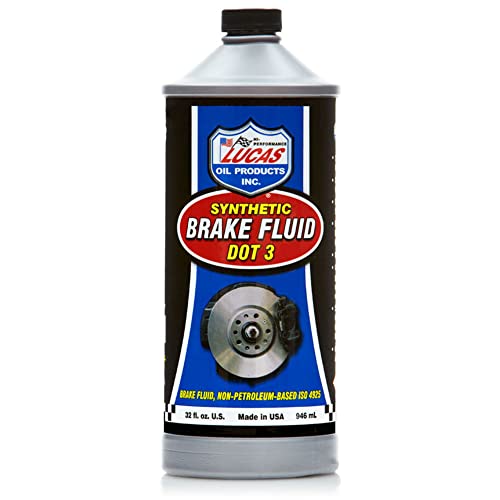
- High quality blend of polyethylene glycol ethers and additives
- Compatible with all brake system rubber components and other brake fluids
- Prevents seal hardening or softening

- Provides an extra margin of safety in extreme braking conditions (packaging may vary)
- Mix of polyglycol ethers ensures hot brake-system operation will not create dangerous vapor
- Excellent for ABS, disc and drum brake systems
Last update on 2026-10-26 / Affiliate links / Images from Amazon Product Advertising API


