If your clear coat is cloudy due to moisture or improper curing, it often clears up naturally as trapped vapors evaporate in warm, low-humidity conditions with good airflow.
You can speed this process with gentle heat or specialized blush removers for uncured finishes.
However, persistent haze usually signals deeper issues like clear coat failure, which won’t improve without repair.
Understanding the causes, signs, and treatment options will help you address and restore your clear coat effectively.
Key Takeaways
- Cloudy clear coat caused by moisture or solvents can naturally clear as trapped vapors evaporate over hours or days.
- Warm, dry, and well-ventilated conditions accelerate the natural dissipation of clear coat cloudiness.
- Partial or uncured clear coats may self-clear, but fully cured defects usually require treatment or repair.
- Persistent haze after polishing often indicates structural failure that won’t resolve without professional restoration.
- Gentle heat or specialized blush removers can help clear moisture-induced cloudiness in uncured finishes.
Common Causes of Cloudy Clear Coat

When you notice a cloudy clear coat, it’s often because moisture or environmental factors interfered during application or curing. High humidity or trapped moisture in the film can cause a milky, foggy appearance known as blushing.
Poor drying conditions, such as low temperature or insufficient airflow, also contribute by preventing solvents from evaporating properly. Sometimes, the issue arises from spraying over a damp surface or applying clear coat too thickly, trapping solvents beneath the surface.
This results in incomplete curing and a hazy finish. If you see cloudiness immediately after spraying, it’s likely a moisture or solvent blush problem. However, if the haze persists after curing, it’s often a sign of clear coat failure, which means the coating’s structure is compromised. Proper surface preparation and maintaining adequate ventilation can help prevent these issues and ensure optimal curing of the clear coat drying and curing times.
When Cloudy Clear Coat Clears on Its Own?
Cloudy clear coat caused by moisture or solvent blush often improves without intervention if environmental conditions become favorable. You’ll notice that fresh haze may clear as the coating dries in warmer, less humid environments.
This happens because trapped moisture or solvents gradually evaporate, restoring transparency. If you keep the item in a stable, warm area with good airflow, the cloudiness can dissipate over hours or days.
Trapped moisture or solvents evaporate over time, clearing haze when kept warm with good airflow.
Using gentle heat from a distance can accelerate this process but requires caution to avoid damage. However, this self-clearing only applies to uncured or partially cured coatings.
Once the clear coat fully hardens or structurally fails, cloudiness typically remains. At that stage, it won’t clear on its own and needs mechanical intervention or refinishing.
Proper environmental conditions and moisture management play a crucial role in whether the cloudiness will dissipate naturally or require professional treatment.
Fixing Cloudy Clear Coat From Moisture and Blush
If moisture or solvent blush causes the haze in your clear coat, you can often restore clarity by carefully applying gentle heat and using specialized blush removers designed for uncured finishes.
Use a heat gun at a safe distance to encourage trapped moisture to evaporate without overheating, which risks warping or blistering.
Blush removers chemically dissolve moisture-induced haze but work only on fresh, uncured clear coats.
After treatment, allow adequate drying time in a warm, low-humidity environment to ensure complete curing.
If haze persists superficially, very light wet sanding with ultra-fine grit followed by polishing may help.
Avoid aggressive abrasion that can thin the clear coat.
Early intervention is critical; once the clear coat fully cures with blush, deeper sanding and reapplication become necessary for restoration.
For best results, ensure the surface is properly prepared and free of contaminants before treatment to prevent adhesion issues related to surface preparation.
Signs of Structural Failure in Cloudy Clear Coat
While moisture and blush-related haze often clears with proper treatment, you need to recognize when cloudiness indicates deeper issues.
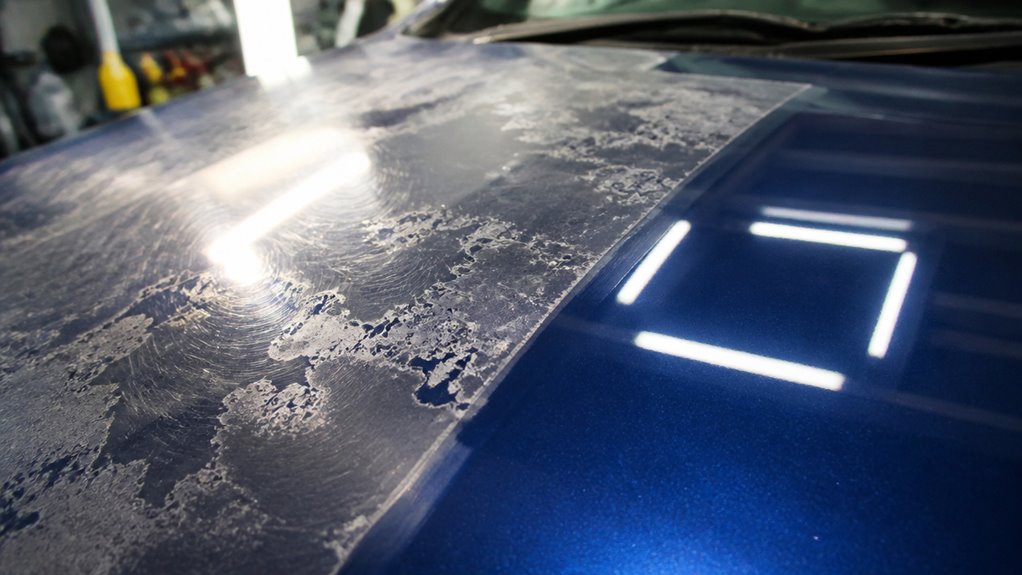
Signs of structural failure in cloudy clear coat include persistent haze that reappears after polishing, indicating the defect lies beneath the surface.
Look for cracking, peeling, or flaking edges; these confirm the clear coat’s integrity is compromised.
A dull, dead finish that resists smoothing or buffing also signals breakdown.
Additionally, if the cloudiness is uniform and unaffected by environmental changes or time, it often means the clear coat has fully cured but lost adhesion or cohesion.
These symptoms mean polishing won’t restore clarity, and the clear coat’s protective function is failing, requiring more extensive intervention beyond surface refinishing.
In such cases, understanding the benefits of ceramic coating protection can help determine appropriate restoration or replacement options.
Repair Options for Persistent Cloudy Clear Coat
When haze persists despite polishing, you’ll need to explore repair options that address the clear coat’s underlying condition. Polishing works only on surface defects. Persistent cloudiness usually signals structural failure or trapped contaminants.
Consider these practical steps:
- Warm, dry curing: Move the item to a controlled environment to promote further curing and moisture escape.
- Gentle heat application: Use a heat gun at a safe distance to drive out trapped moisture without damaging the finish.
- Wet sanding and recoating: Lightly sand the affected area with high-grit sandpaper. Then apply a new clear coat layer for uniform clarity.
- Full strip and repaint: If the clear coat is cracked, peeling, or deeply contaminated, complete removal and refinishing is necessary for a lasting repair.
Choose the method based on the haze severity and clear coat condition for effective restoration. After repair, applying a protective sealant is essential to shield the surface and maintain clarity over time.
Frequently Asked Questions
Can Cloudy Clear Coat Damage the Underlying Paint?
Cloudy clear coat itself doesn’t directly damage the underlying paint, but it can signal problems that may.
If the clear coat is structurally failing, peeling, cracking, or delaminating, it exposes the paint to moisture, UV rays, and contaminants.
This exposure can degrade the paint over time.
How Long Does It Take for Cloudy Clear Coat to Fully Cure?
Think of clear coat curing like a slow sunrise: gradual and steady.
Typically, it takes about 24 to 48 hours for a clear coat to fully cure under ideal conditions.
However, full chemical hardening can continue for up to 7 days. Humidity, temperature, and airflow impact this timeline.
To guarantee a durable finish, keep the surface warm and dry. Avoid moisture or contaminants during this critical curing window.
Does Temperature Affect the Likelihood of Clear Coat Cloudiness?
Yes, temperature directly affects clear coat cloudiness.
When you apply clear coat in low temperatures, drying slows, increasing trapped moisture and solvent blush, causing haze.
High temperatures speed curing but risk blistering if too hot.
For best results, maintain moderate, consistent temperatures during application and curing.
You can reduce cloudiness likelihood by avoiding extreme cold or heat, ensuring proper airflow, and allowing sufficient drying time in ideal conditions.
Is Cloudy Clear Coat More Common on Certain Vehicle Colors?
Yes, cloudy clear coat tends to be more noticeable on darker vehicle colors like black, navy, and deep reds because haze contrasts strongly against those shades.
Lighter colors, such as white or silver, can still develop cloudiness, but it’s less apparent.
You should inspect dark-colored vehicles carefully after clear coat application, especially under humid or cool conditions.
Defects like blushing or trapped moisture stand out more prominently.
Can Environmental Pollutants Cause Clear Coat Cloudiness?
You mightn’t expect it, but yes, environmental pollutants can cause clear coat cloudiness.
Contaminants like industrial fallout, acid rain, or airborne chemicals often settle on your paint, leading to surface haze or etched spots.
While this cloudiness isn’t usually structural, it can degrade the clear coat’s appearance.
You’ll want to address these pollutants quickly through proper cleaning and polishing to prevent long-term damage or the need for more intensive repairs.
Conclusion
If your cloudy clear coat feels like a foggy window, don’t assume it’ll vanish on its own. Sometimes it clears like morning mist, but often it signals deeper issues.
Moisture and blush can be wiped away with care, yet structural failure demands precise repair.
Think of your clear coat as a shield. When it’s compromised, timely action preserves your paint’s integrity and shine.
Address problems early to keep your finish crystal clear and protected.