
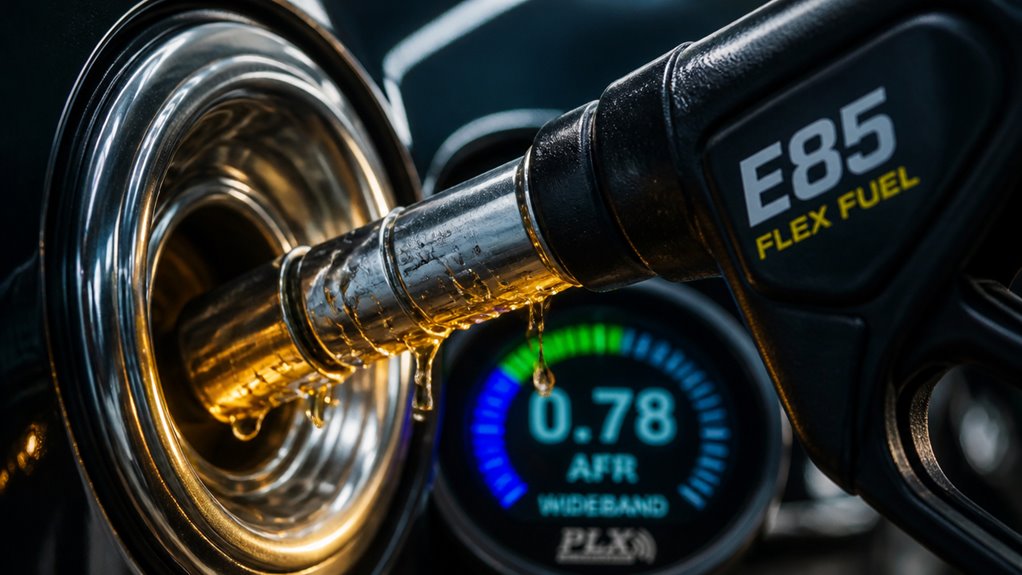
If you’re running E85, target a stoichiometric air-fuel ratio around 9.8:1 by mass for complete combustion.
This is leaner than gasoline’s 14.7:1 due to ethanol’s chemical makeup.
Use lambda to compare mixtures consistently. Lambda 1.0 always means stoich, simplifying tuning across fuel types.
E85 needs about 35–40% more fuel volume, so your system must support higher flow.
Understanding these basics guarantees precise fueling and performance before exploring detailed tuning strategies.
Key Takeaways
- The stoichiometric air-fuel ratio (AFR) for E85 is approximately 9.8:1 by mass.
- E85 requires more fuel volume than gasoline due to ethanol’s lower energy density.
- Lambda 1.0 corresponds to stoichiometric AFR regardless of ethanol content, including E85.
- AFR targets must be adjusted when switching from gasoline to E85 to maintain proper combustion.
- Accurate wideband calibration is essential for correct AFR readings and effective E85 tuning.
What Is the Stoichiometric AFR for E85 Fuel?

The stoichiometric air-fuel ratio (AFR) for E85 fuel, a blend consisting of approximately 85% ethanol and 15% gasoline, is about 9.8:1 by mass.
This ratio differs notably from pure gasoline’s stoichiometric AFR of roughly 14.7:1.
Since ethanol’s stoichiometric AFR is around 9.7:1, the E85 blend’s AFR aligns closely with ethanol’s value due to its high ethanol content.
When you measure AFR, keep in mind it’s fuel-specific.
E85 demands more fuel mass per unit of air to maintain stoichiometry.
This precise stoichiometric ratio guarantees complete combustion where all oxygen reacts with fuel, minimizing excess air or fuel.
Accurately knowing this ratio is vital for tuning and controlling emissions when running engines on E85.
Due to ethanol’s oxygen content, E85 mixtures tend to run leaner, affecting combustion efficiency and engine temperature regulation.
Why E85 AFR Requires More Fuel Than Gasoline?
You might be surprised to learn that E85 has a stoichiometric air-fuel ratio that’s significantly lower than gasoline’s. While gasoline sits at about 14.7:1, E85 comes in around 9.8:1. What does that mean for you? Simply put, it needs more fuel by volume to achieve complete combustion.
So, why is that the case? Well, it boils down to the fact that ethanol, which makes up most of E85, has less energy per unit volume compared to gasoline. Because of this, you have to inject more fuel to produce the same amount of power.
Understanding these differences in stoichiometry and energy content is really important. It can help you optimize your fueling strategies if you’re working with E85. Additionally, just as Diesel 1 and Diesel 2 differ in energy density and combustion characteristics, fuels like E85 require tailored management of fuel efficiency to maximize performance.
Stoichiometric Ratio Differences
Since E85 contains a markedly higher proportion of ethanol than gasoline, it requires a much richer air-fuel mixture to achieve stoichiometric combustion.
You’ll notice the stoichiometric AFR for E85 is approximately 9.8:1, compared to gasoline’s 14.7:1. This difference stems from ethanol’s chemical composition, which demands more fuel molecules per unit of oxygen to reach ideal combustion.
When you tune for E85, you must increase fuel delivery by about 35-40% to maintain the stoichiometric balance. This richer mixture guarantees complete combustion and peak engine performance.
Keep in mind, although lambda remains constant at 1.0 for stoichiometric mixtures, the AFR shifts depending on fuel type. Always adjust your fueling strategy accordingly to avoid lean or rich conditions.
Blends with higher ethanol content require careful consideration of fuel system suitability to ensure optimal performance and avoid damage.
Fuel Volume and Energy
Understanding fuel volume and energy content helps explain why E85 requires a richer air-fuel ratio than gasoline. Ethanol’s lower energy density means you need roughly 35-40% more fuel volume to deliver the same power output.
While gasoline’s stoichiometric AFR sits near 14.7:1, E85’s is closer to 9.8:1 due to ethanol’s chemical properties. This means more fuel mass and more fuel volume must enter the combustion chamber to maintain the correct oxygen-to-fuel ratio.
Despite increased fuel volume, E85’s higher octane rating and cooling effect improve knock resistance, allowing more aggressive tuning. You must also consider fuel system capacity upgrades, as injectors and pumps need to handle this increased flow.
Accurately setting AFR stoichiometry in your tuning software guarantees proper fueling and peak engine performance with E85. Additionally, proper ECU calibration ensures these adjustments are optimized for efficiency and engine safety.
How to Convert Gasoline AFR Targets to E85 AFR?
When converting gasoline AFR targets to E85 AFR, you need to account for the markedly lower stoichiometric air/fuel ratio of E85, which is about 9.8:1 compared to gasoline’s 14.7:1.
To convert, first identify the gasoline AFR target and calculate its lambda value by dividing the target AFR by 14.7. Then, multiply that lambda by 9.8 to find the equivalent E85 AFR target.
Convert gasoline AFR to E85 by dividing by 14.7, then multiplying by 9.8 for the correct target.
For example, a gasoline AFR of 12.0 corresponds to a lambda of 0.82 (12.0/14.7). Multiplying 0.82 by 9.8 yields an E85 AFR of approximately 8.0.
This conversion guarantees you maintain the same mixture strength relative to stoichiometry. This is critical for proper combustion and tuning.
Always verify your wideband controller’s stoich setting to avoid inaccurate AFR readings.
Why Lambda Matters for Accurate E85 Tuning?
Converting gasoline AFR targets to E85 AFR highlights the significant difference in stoichiometric ratios between the fuels.
However, relying solely on AFR can lead to inaccuracies in tuning. AFR values depend on fuel composition, so an AFR of 12 on gasoline doesn’t represent the same mixture strength on E85.
Lambda normalizes mixture strength relative to stoichiometry, making it a universal metric. When tuning E85, using lambda guarantees you’re targeting the correct relative air-fuel mixture regardless of fuel blend variations.
This is critical since E85’s stoich ratio (~9.8) differs substantially from gasoline’s (14.7). Without lambda, you risk over- or under-fueling due to misinterpreted AFR readings.
Accurate lambda-based tuning improves combustion efficiency, knock resistance, and overall engine performance on E85.
Common AFR and Lambda Targets When Tuning E85
When you’re tuning for E85, it’s important to know that the stoichiometric air-fuel ratio (AFR) is quite different from what you’d find with gasoline. For E85, you’re looking at around 9.8:1, while gasoline sits at 14.7:1.
Now, using lambda values can make things a lot easier when interpreting mixture strength across different fuels. With lambda, 1.0 always means you’re at stoichiometric, no matter what fuel you’re working with.
As you adjust your targets, keep in mind that they’ll change based on whether you’re aiming for a richer or leaner mixture. So, getting your AFR and lambda calibrated just right is really crucial for achieving peak performance and ensuring safety.
Lambda Versus AFR
Although tuning E85 requires understanding both AFR and lambda, relying on lambda values provides a consistent reference across different fuels by normalizing mixture strength.
You’ll find lambda unifies mixture interpretation since it defines stoichiometry as 1.0 regardless of fuel type. E85’s stoich AFR is about 9.8, while gasoline’s is about 14.7.
Using AFR alone risks confusion due to fuel-specific stoich differences, especially when switching between gasoline and E85. For example, a lambda of 0.8 corresponds to roughly 7.8 AFR on E85 but 11.76 AFR on gasoline.
By targeting lambda values, you guarantee accurate mixture strength control and facilitate consistent tuning outcomes. This approach avoids errors caused by incorrect stoich calibration on wideband meters.
Maintaining lambda-based tuning simplifies fuel system adjustments and optimizes combustion efficiency across varying ethanol blends.
For precise tuning and diagnostics, many enthusiasts use advanced OBD2 scanners that support live data streaming and ECU coding to monitor and adjust fuel parameters in real time, enhancing accurate diagnostics.
Stoichiometric Ratios Explained
Since E85’s stoichiometric air-fuel ratio (AFR) differs markedly from gasoline’s, understanding these ratios is critical for effective tuning. Gasoline’s stoich sits near 14.7:1, while E85’s is approximately 9.8:1 due to its higher ethanol content.
This means you’ll need roughly 35-40% more fuel volume for E85 to maintain stoichiometry. Lambda simplifies tuning by normalizing mixture strength across fuels; a lambda of 1.0 always indicates stoich regardless of fuel type.
When tuning E85, targeting lambda rather than AFR can prevent confusion since AFR values shift with fuel composition. For example, a lambda of 0.8 equates to about 11.76 AFR on gasoline but roughly 7.8 AFR on E85.
Correct stoich calibration on your wideband controller guarantees accurate AFR readings and precise fuel delivery. Understanding the impact of fuel composition is essential, as it influences combustion characteristics and tuning strategies.
Targeting Rich Or Lean
Because E85 requires substantially more fuel for a given air mass, you must carefully select your target mixture to balance performance, efficiency, and engine safety.
When tuning, targeting lambda rather than raw AFR simplifies adjustments since lambda normalizes mixture strength across fuels. For E85, stoichiometric AFR is about 9.8:1, so a lambda of 0.8 corresponds to roughly 7.8 AFR, markedly richer than gasoline’s 11.76 AFR at the same lambda.
You’ll often target richer mixtures under boost, around lambda 0.75–0.85, to leverage E85’s knock resistance and cooling properties, enhancing performance and protecting the engine. Leaner mixtures may reduce fuel consumption but increase knock risk.
Precise stoich calibration in your wideband controller is critical to avoid erroneous AFR readings and to ensure your rich or lean targets translate correctly into fueling commands.
How E85’s High Octane Improves Engine Performance?
When you run E85, its high octane rating, often 105 or higher, lets your engine withstand greater compression and more aggressive ignition timing without knocking.
This means you can advance spark timing or increase boost pressure safely, harnessing more power from each combustion cycle.
E85’s resistance to detonation stems from ethanol’s higher heat of vaporization and flame speed. This cools the intake charge and promotes stable combustion.
Although E85 has lower energy per volume than gasoline, the increased fuel flow compensates, delivering higher total combustion energy.
You’ll also benefit from reduced knock, allowing for leaner ignition settings and higher thermal efficiency.
This fuel’s characteristics enable you to optimize engine calibration for improved performance, especially in turbocharged or high-compression applications.
You can do this without compromising reliability or risking pre-ignition damage.
For maintaining optimal engine health with E85, selecting the appropriate oil viscosity rating is essential to ensure adequate lubrication under varying temperature conditions.
How to Upgrade Your Fuel System for E85’s Higher Flow?
Although E85 delivers benefits like higher octane and improved knock resistance, you’ll need to upgrade your fuel system components to handle the roughly 35-40% increase in fuel volume required.
Start by selecting larger fuel injectors calibrated for E85’s lower stoichiometric AFR of about 9.8:1. This ensures they can supply the increased flow without exceeding duty cycle limits.
Upgrade your fuel pump to maintain adequate pressure and flow rate under higher demand.
Replace fuel lines with ones rated for ethanol compatibility and larger diameter to reduce pressure drop.
Finally, make certain your fuel pressure regulator supports the elevated flow while maintaining stable pressure.
These steps collectively prevent lean conditions and maintain consistent combustion. This optimizes E85’s performance potential and protects engine components from fuel starvation or improper mixture delivery.
Note that improper fuel system upgrades can lead to fuel starvation, which risks engine damage and reduced performance.
Why Lambda-Based Tuning Works Best for Flexible Fuel Systems?
Since flexible fuel systems must accommodate varying ethanol blends, relying on lambda-based tuning guarantees consistent mixture control regardless of fuel composition.
Flexible fuel systems ensure precise mixture control by using lambda-based tuning across all ethanol blends.
Lambda normalizes the air-fuel mixture strength independent of fuel stoichiometry, maintaining a lambda of 1.0 at stoichiometric conditions whether you’re running pure gasoline, E85, or any blend in between.
This approach removes the guesswork involved in adjusting AFR targets that shift with ethanol content, from about 14.7:1 for gasoline to roughly 9.8:1 for E85.
By tuning to lambda rather than fuel-specific AFR values, you secure precise combustion control, optimize power, and avoid detonation risks.
Since fuel composition fluctuates in flexible fuel vehicles, lambda-based tuning adapts dynamically. It provides reliable feedback to your engine management system and enables consistent performance and emissions across all ethanol blend levels.
Additionally, maintaining optimal friction reduction within the transmission can help ensure smooth shifting and overall vehicle performance when using different fuel blends.
Practical Tips to Avoid AFR and Tuning Mistakes With E85
Mastering E85 tuning requires careful attention to air-fuel ratio calibration to prevent common mistakes that compromise performance and reliability.
First, always set your wideband controller’s stoichiometric AFR to about 9.8:1 for E85, not gasoline’s 14.7:1, to guarantee accurate AFR readings.
Avoid interpreting AFR targets without considering lambda; tuning by lambda normalizes mixture strength and eliminates fuel-specific confusion.
Remember, E85 demands approximately 35–40% more fuel volume, so verify your fuel system’s capacity. Injectors, pump, and lines must support higher flow rates.
During tuning, target lambda values rather than gasoline AFR equivalents to maintain mixture precision, especially under boost or wide-open throttle.
Finally, calibrate your wideband sensor properly and confirm fuel composition regularly to prevent lean or rich conditions that can lead to knock or power loss.
Using high-quality synthetic oils like Mobil 1 synthetic oil can help maintain engine reliability under the increased stresses of E85 tuning.
Frequently Asked Questions
How Does E85 Impact Cold Start and Warm-Up Behavior?
E85 makes cold starts trickier because ethanol vaporizes less readily than gasoline. You’ll notice longer cranking times and rougher idle during warm-up. Your engine management system must enrich the mixture more to compensate.
Once warm, combustion stabilizes due to ethanol’s cooling effect and high octane. This allows you to run more aggressive timing. You’ll need to ensure your fuel system handles higher flow rates during these conditions to avoid lean issues.
What Are the Environmental Benefits of Using E85 Fuel?
Like a gust of clean air in combustion, E85 reduces greenhouse gas emissions by cutting carbon dioxide output compared to gasoline.
You’ll find it lowers particulate matter and toxic pollutants due to ethanol’s cleaner burn.
Since it’s renewable and sourced from plant materials, it decreases reliance on fossil fuels.
However, you must consider the full lifecycle, as production emissions vary.
Can E85 Cause Long-Term Engine Wear or Damage?
E85 itself doesn’t inherently cause long-term engine wear if your fuel system and engine are properly tuned and maintained.
However, its higher ethanol content can lead to increased fuel system corrosion and wear in older engines not designed for alcohol fuels.
You’ll need compatible materials, upgraded injectors, and fuel lines.
Also, poor tuning or running too lean can cause damage.
How Does Temperature Affect E85 Fuel Vaporization and Combustion?
You might think E85 vaporizes like gasoline, but it actually needs higher temperatures due to ethanol’s lower volatility.
As temperature rises, E85 vaporizes more efficiently, improving combustion and reducing cold-start issues.
However, at low temperatures, poor vaporization can cause incomplete combustion and rough idling.
You must account for this in tuning by enriching fuel delivery during cold starts and ensuring your system manages temperature variations for peak performance and emissions control.
Are There Specific Maintenance Requirements for Vehicles Running on E85?
Yes, you’ll need to maintain your vehicle’s fuel system more vigilantly with E85.
Ethanol’s corrosive nature demands corrosion-resistant components, so regularly inspect fuel lines, injectors, and pumps for wear.
Replace fuel filters more frequently to prevent clogging from ethanol’s solvent effects.
Also, make certain your spark plugs and ignition timing are properly adjusted to handle E85’s higher octane and different combustion characteristics for peak performance and longevity.
Why Accurate AFR for E85 Matters: Boost Efficiency and Engine Longevity
When you switch to E85, remember that its stoichiometric AFR demands more fuel. Its high octane lets your engine perform better.
Tuning E85 isn’t just about richer mixtures; it’s about precision in lambda-based adjustments. This ensures efficiency and power.
Upgrading your fuel system aligns perfectly with these needs. By understanding and applying these principles, you don’t just run E85; you optimize it.
This turns a simple fuel change into a technical advantage.


