
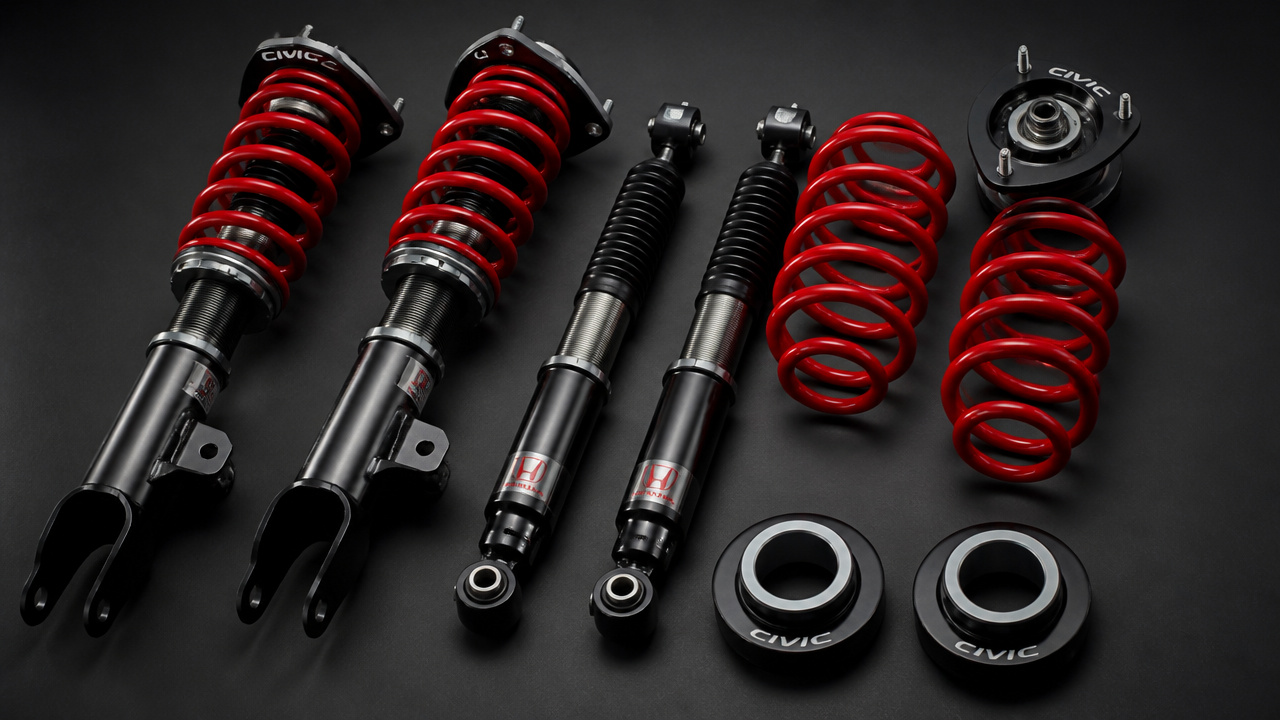

- Truhart StreetPlus Coilovers
- Expert Choice
- Top Rated
- Trusted Pick
Factory Civic suspension can feel soft, floaty, and unsure. Potholes jolt through the cabin. Lowering springs often add scrape without real control.
Truhart StreetPlus tightens the 2016+ Civic with a firmer, calmer ride. BC Racing BR Series adds mono-tube damping and camber plates for sharper response after lowering.
Godspeed MonoSS brings 16-click damping and a 52mm stainless steel body. It fits FC owners who want more tuning range and durability.


Honda Civic Coilovers for Sharper Street Control
Dialing in a Civic’s suspension sharpens steering, controls body roll, and settles the chassis; the right coilovers turn daily driving and cornering into a more confident experience.
1. Truhart StreetPlus Lowering Coilovers for 2016+ Civic Sedan/Coupe and Hatch

- Truhart StreetPlus Coilovers
Ride height is where a Civic can feel either dialed-in or oddly vague, and a small change there affects more than stance. The StreetPlus setup gives you a more controlled starting point for that balance, especially if you want firmer response without turning the car into a punishing daily.
Built with a steel construction and a lightweight design, these coilovers are aimed at drivers who want straightforward suspension changes on compatible sedan, coupe, and hatchback models. Truhart’s StreetPlus layout helps you fine-tune the car’s posture while keeping the hardware simple to live with.
The red finish adds a clean visual touch, but the real value is in how the setup supports lowered fitment and a more planted feel. For street use, that usually means less float, tighter body control, and a setup that feels more purposeful over stock components.
Because the kit is matched to specific non-Si applications, it fits the owner who wants a focused upgrade instead of a universal part that asks you to compromise. The single-kit format keeps the package straightforward, and the suspension geometry stays aimed at your chassis rather than a broad one-size-fits-all range.
Best for: Civic owners who want a firmer, lower street setup for sedan, coupe, or hatchback models without stepping into an overly harsh track-only setup.
Pros:
- Designed for specific Civic body styles
- Steel build for dependable hardware
- Lightweight construction
- Helps achieve a lower, cleaner stance
- Straightforward street-focused suspension upgrade
Cons:
- Not intended for Si applications
- May feel firmer than stock on rough pavement
2. maXpeedingrods Adjustable Lowering Kit for Honda Civic 1988-2000, CRX

- 【Fit Perfectly】for Honda Civic 1988-1991 EC ED EE EF Rear fork type bracket model only; for...
- 【Spring Rate】 Front Spring rate: 8 kg/mm (448 lbs/in) & 5 kg/mm (280 lbs/in) with spring...
- 【Adjustable Height】 The height is adjustable for 1-3 inches(Notice: does not keep to the...

Tight wheel gaps and vague turn-in can make an older Honda feel less tied down than it should. A height-adjustable suspension setup gives you a way to correct that without chasing a harsh, overdone ride.
MaXpeedingrods builds this kit around 1-3 inches of drop, so you can set the stance and response you want. The twin-tube design adds a longer stroke and helps keep the car more settled over uneven pavement, while still sharpening steering feel.
Front spring rates of 8 kg/mm and rear rates of 5 kg/mm give the chassis a firmer, more controlled attitude. The 6061 aluminum alloy body with T6 treatment adds strength and durability, and the powder-coated finish helps the hardware hold up better in daily use.
Fitment covers several Civic, CR-X, CR-X del Sol, and Integra chassis, so you need to match the exact generation before ordering. The included C spanners make setup easier, and the fully loaded assembly is aimed at a straightforward installation.
Compared with a basic spring swap, this kit gives you more control over ride height and chassis balance. It is a practical choice if you want better steering response, a lower stance, and a suspension package built for older Honda platforms.
Best for: Honda owners who want a lower, more responsive street setup with adjustable ride height and platform-specific fitment.
Pros:
- Height adjustable for a tailored stance
- Twin-tube design for a more compliant ride
- Firmer spring rates for sharper handling
- 6061 aluminum body with T6 treatment
- Includes front and rear coilovers plus C spanners
Cons:
- Lowering range may be too much for drivers wanting stock-like clearance
- Ride firmness could feel busy on rough roads for some users
3. Rev9 Hyper-Street ONE Adjustable Lowering Kit for Honda Civic 2006-2011

- Compatible With Honda Civic (FA/FG/FD) 2006 2007 2008 2009 2010 2011
- Spring Rate: Front - 6 kg/mm (336 lbs/inch) | Rear - 10 kg/mm (115.21 lbs/inch) // Damping Levels...
- Mono-Tube Shock Design With 16 Levels of Damping Force Adjustment Combined With Upgrade Spring Rate.
Dialing in a Civic’s stance usually exposes the real tradeoff: comfort, grip, or ride height. A setup that only drops the car can leave you chasing bounce and poor control, which is why the tune matters as much as the lowering number.
Rev9’s Hyper-Street ONE kit uses a mono-tube shock design with 16 damping levels, so you can fine-tune response instead of living with one fixed feel. The front pillow ball top mounts add sharper steering feedback, while the rear keeps the factory top mounts for a simpler fitment approach.
Spring rates are set at 6 kg/mm in front and 10 kg/mm in the rear, giving the chassis a firmer, sport-oriented balance. The lowering range targets about 1.25 to 2.25 inches, which helps reduce excess wheel gap without pushing the car into an impractical super-low setup.
That makes it a solid match for street cars that need better handling control and a more settled ride after lowering. Rev9 also keeps the package focused on practical performance, with no wasted extras and a layout meant for experienced installation.
Best for: Civic owners who want adjustable street performance, moderate lowering, and a firmer, more controlled feel.
Pros:
- 16 damping settings for tailored response
- Mono-tube construction for consistent shock behavior
- Front pillow ball mounts for sharper feedback
- Moderate drop range for usable street clearance
- Sport-tuned springs for improved chassis control
Cons:
- Installation may be better suited to experienced professionals
- Rear reuse of factory top mounts may not suit buyers wanting a full replacement setup
4. FAPO RACING PS+ Adjustable Suspension Kit for Honda Civic 1988-2000

- COMPATIBLE: For Honda Civic 4th Gen (Rear Fork) EF/ED 1988-1991; For Honda Civic 5th Gen(Rear Fork...
- 16 DAMPER ADJUSTABLE: 0-8 level suggest for race tracks use mountain anfractuosities use; 8-16 level...
- SPRING RATE: Front:10 kg/mm(560 lbs/inch), Rear: 8 kg/mm(448 lbs/inch), Spring Preload 7-10mm; And...
Tight turn-in and inconsistent ride height usually show up first on older Hondas, especially when stock suspension has already lost its control. A setup with real damping adjustment gives you a way to tune the car instead of living with one compromise.
FAPO RACING builds this PS+ kit around a 16-step damper range, so you can soften it for street use or firm it up for more aggressive driving. The full-length body lets you change ride height separately from spring preload, which helps keep the chassis sitting where you want it.
Front spring rates are 10 kg/mm and the rear uses 8 kg/mm, a combination that supports sharper response without turning the car into a harsh daily. The mono-tube layout, aluminum construction, and included wrenches make the setup practical for garage installs and repeated adjustments.
Fitment covers a wide spread of Honda Civic, CR-X, Del Sol, and Acura Integra chassis from 1988-2001 with rear fork mounting. That makes it a strong option if you want handling gains, a lower stance, and a more composed feel on track, drift sessions, or normal roads.
Best for: Enthusiasts tuning older Honda and Acura chassis who want adjustable ride height, firmer control, and a street-to-track suspension upgrade.
Pros:
- 16 damping levels for quick tuning changes
- Full-length height adjustment for a lower stance
- Balanced spring rates for responsive handling
- Fits multiple Honda and Acura rear-fork chassis
- Includes wrenches for setup changes
Cons:
- Ride firmness may feel too aggressive for some daily setups
- Rear-fork fitment limits use to specific chassis generations
5. Godspeed MonoSS Fully Adjustable Lowering Kit for Honda Civic Coupe/Sedan FC

- Compatible With Honda Civic Coupe / Sedan Non-SI (FC) 2016 2017 2018 2019 2020 2021; 50mm Front...
- Spring Rate (Front/Rear) : 6 kg/mm || 6 kg/mm; Damping Levels: 16 Rebound Force Levels
- 52mm Mono-Tube Stainless Steel Shock With 16 Levels of Damping Adjustment Corresponds to Daily...
Tuning the FC chassis often means choosing between a comfortable street setup and a sharper track feel. The Godspeed MonoSS kit bridges that gap with 16-click damping adjustment, so you can firm up response without making the car feel overly harsh.
Built around a 52mm mono-tube stainless steel shock, it uses a performance internal piston and Koyo Japan 6204z bearing for a smoother stroke. The front and rear 6 kg/mm spring rates give the chassis a more settled, controlled attitude during cornering and braking.
Independent spring tension and ride-height adjustment let you fine-tune stance and geometry separately, which is useful when you want the car to sit right without giving up usable travel. Powder-coated CNC-machined aluminum and carbon steel hardware add durability where it matters.
Godspeed also uses racing-grade shock oil with a high viscosity index, and the dampers are rebuildable when wear eventually shows up. For Civic Coupe and Sedan non-Si owners, that means a suspension package built for daily driving precision and occasional weekend abuse.
Best for: Civic non-Si owners who want adjustable street manners, a lower stance, and firmer control for spirited driving.
Pros:
- 16 damping settings for quick tuning changes
- Separate ride-height and spring tension adjustment
- Mono-tube stainless steel shock construction
- Matched 6 kg/mm front and rear spring rates
- Rebuildable dampers for long-term serviceability
Cons:
- Designed for non-Si FC models only
- Best results may require professional installation and alignment
6. EVIL ENERGY Adjustable Lowering Suspension Kit for 1996-2000 Honda Civic

- 【Compatibility】- Evil Energy coilovers are compatible for Honda Civic (EJ/EK/EM/EN...
- 【1 - 3 inches Height Adjustable】- The coil suspension kit reduces the chassis height of the car...
- 【Extremely Durable Coil Spring】- Heat-treated high-strength steel spring with anti-corrosion...
Body roll and vague steering can show up fast on an older Civic, especially once the chassis starts leaning harder through corners. EVIL ENERGY answers that with a height-adjustable suspension setup that lets you trim the stance while sharpening response. The result is a more planted feel without turning the car into a harsh daily.
Built for 1996-2000 EJ, EK, EM, and EN models, the kit offers 1 to 3 inches of ride-height adjustment for dialing in fitment and posture. That lower center of gravity helps reduce turning noise and supports a more direct steering feel, which matters when you want the car to react instead of float.
The twin-tube design is aimed at smoother movement over uneven pavement, where single-path setups can feel busy. Heat-treated steel springs and an anti-corrosion coating add long-term durability, while the stated spring rates help support more controlled weight transfer in spirited driving.
Steel construction across the body, mounts, and piston rod adds rigidity where it counts. For long-term street use, that means the hardware is built to keep its shape and function through repeated compression, not just sit low for photos. Installation is best left to a professional, especially if you want the alignment and ride height set correctly.
EVIL ENERGY gives your Civic a practical path to a firmer, lower setup without losing everyday drivability.
Best for: Civic owners with EJ, EK, EM, or EN chassis cars who want adjustable stance, sharper response, and a street-friendly ride.
Pros:
- Height adjusts from 1 to 3 inches
- Twin-tube layout helps smooth rough roads
- Steel springs and mounts add durability
- Supports sharper steering feel and stability
- Fitment is specific to 1996-2000 Civic chassis
Cons:
- Ride quality may feel firmer than stock
- Professional installation is strongly recommended
7. BC Racing BR Series Suspension Kit for Honda Civic Hatchback 1.5T 2017-2021

- Optimized Handling: Upgrade your Honda 2017-2021 with our Honda Civic Coilovers BR Series, featuring...
- Customizable Ride Height: Achieve your desired stance with height-adjustable BC Coilovers...
- Durability & Rebuildability: The BC Racing coilovers BR Series feature a mono-tube shock design and...
Tuning a hatchback for sharper turn-in usually exposes the weak link fast: stock suspension runs out of adjustment before the chassis does. BC Racing’s BR Series gives you a way to correct that with height adjustment through the shock body, so you can set stance without sacrificing spring travel the wrong way.
The mono-tube design helps keep damping consistent, while the included front camber plates give you room to fine-tune alignment after lowering. That matters when you want cleaner steering response and less uneven tire wear from a setup that sits lower than factory ride height.
Built with aluminum components, dust boots, and a rebuildable layout, this kit is aimed at long-term use rather than a one-time drop. The damping curve and linear piston design let you dial in a ride that feels controlled on the street without turning every bump into a problem.
For your 2017-2021 Honda Civic hatchback 1.5T, the result is a more settled chassis with better cornering balance, adjustable ride height, and alignment control that actually matches the lower stance. BC Racing keeps the setup focused on real-world driving, not just appearance.
Best for: Honda Civic hatchback owners who want a lower stance, sharper handling, and suspension tuning they can actually adjust.
Pros:
- Height adjusts through the shock body
- Front camber plates included
- Mono-tube shock design
- Rebuildable for long-term use
- Aluminum construction with dust boots
Cons:
- May need alignment after installation to get the best results
- Ride stiffness could feel firm for drivers who prefer a softer factory setup
Top Honda Civic Coilovers With Core Specs
| Product Name | Fitment | Damper Adjustment | Spring Rate | Construction / Key Material |
|---|---|---|---|---|
| Truhart Civic StreetPlus | 16+ Civic Sdn/Cpe, 22+ Hatchback Excl Si | Not specified | Not specified | Steel; Lightweight design |
| maXpeedingrods Civic Classic | Civic 1988-2000, CRX 1988-1991 | Not specified | Front 8 kg/mm, rear 5 kg/mm | 6061 aluminum alloy with T6 |
| Rev9 Civic Hyper-Street | Civic FA/FG/FD 2006-11 | 16 levels | Front 6 kg/mm, rear 10 kg/mm | Mono-tube; metallic finish |
| FAPO Civic PS+ Kit | Civic 1988-2000, Del Sol 1993-1997 | 16 level adjustable | Front 10 kg/mm, rear 8 kg/mm | Mono-tube; Aluminum, Spring Steel, Rubber |
| Godspeed Civic MonoSS | Civic Coupe/Sedan Non-Si FC 2016-21 | 16 click damping | Front 6 kg/mm, rear 6 kg/mm | 52mm Mono-Tube Stainless Steel |
| EVIL ENERGY Civic Twin-Tube | Civic EJ/EK/EM/EN 1996-2000 | Not specified | Front 9.8kg/mm, rear 5kg/mm | Twin-Tube; steel body |
| BC Racing Civic BR Series | Civic 2017-2021 Hatchback 1.5T | Not specified | Not specified | Mono-tube; dust boots |
What Actually Matters Before Buying the Best Coilovers for Honda Civic?

Picking the best coilovers for honda civic isn’t just about dropping the car until the wheels sit flush. The right setup changes how the chassis settles, how the steering loads up, and how much control you keep over bad pavement. The wrong one can make a Civic feel busy, nervous, or strangely stiff without adding real grip.
Honda Civics respond fast to suspension changes, which is why small details matter more than most buyers expect. A coilover that fits your generation, matches your driving style, and leaves room for alignment adjustment usually ends up feeling better than a “sporty” setup that only looks good in a parking lot.
Fitment for Your Exact Civic Chassis
Fitment is the first hard stop because the wrong Civic generation can make the entire kit useless. A coilover built for a 2016+ sedan won’t work like one for an EK or EF chassis, even if both are called “Honda Civic.”
Mounting points, shock length, spring perch shape, and top hat design all change across generations. The BC Racing BR Series for the 2017–2021 hatchback 1.5T is built around that newer chassis layout, while maXpeedingrods and FAPO target older 1988–2000 platforms. That difference matters because stroke length and body geometry affect how much suspension travel remains after lowering. If the kit doesn’t match the chassis exactly, you can end up with poor clearance, wrong ride height range, or uneven geometry that no alignment can fully clean up.
Ignoring fitment usually leads to a suspension that looks installed but behaves wrong. At best, you waste money. At worst, you create tire rub, bad camber behavior, or a car that feels skittish over bumps because the coilovers were never meant for that shell in the first place.
Damper Adjustment and Ride Control
Damping adjustment is what separates a stance-only setup from one that can actually live on real roads. It controls how fast the shock compresses and rebounds, which changes how the Civic reacts to braking, cornering, and broken pavement.
Products like the Rev9 Hyper-Street ONE and FAPO PS+ use 16-level adjustment, while the Godspeed MonoSS gives you 16-click tuning. That range lets you firm up body control without locking yourself into one harsh setting. A mono-tube shock generally reacts faster than a twin-tube design because the piston works in a single pressurized chamber, which helps keep damping more consistent during repeated load changes. On the other hand, a twin-tube setup like the EVIL ENERGY kit can feel a little more forgiving on rough streets. The real point is simple: more usable adjustment gives you room to match spring rate, tire sidewall, and road quality.
Skip this factor and the car may feel okay for a week, then start getting old fast. Too little damping can cause bouncy rebound and lazy turn-in. Too much can make the Civic skip across mid-corner bumps instead of settling into the pavement.
Spring Rate Balance Front to Rear
Spring rate decides how much force is needed to compress the suspension, and it has a huge effect on balance. The Civic’s front and rear ends don’t need the same rate, and getting that ratio wrong can make the car understeer, over-rotate, or feel weirdly inconsistent.
Look at the spread in the lineup: maXpeedingrods uses 8 kg/mm front and 5 kg/mm rear, while Rev9 flips to 6 kg/mm front and 10 kg/mm rear. Godspeed stays even at 6 kg/mm front and rear, which usually makes the chassis easier to predict for street use. Higher front rate often sharpens steering response but can reduce compliance over sharp bumps. Higher rear rate can help rotation, but too much can make the back end feel nervous during lane changes or rough-camber turns. Spring choice is really a balance between load transfer, traction, and comfort.
Ignore spring rates and the Civic may never feel settled. The car can bottom out too easily, chatter over expansion joints, or push wide in corners because the chassis is fighting itself instead of working as one unit.
Body Material and Corrosion Resistance
Construction material matters because coilovers live in road spray, heat cycles, and constant adjustment. If the threads seize or the body corrodes, ride-height changes become a chore instead of a tuning tool.
The lineup shows a few different approaches: Truhart uses steel, maXpeedingrods uses 6061 aluminum alloy with T6, and Godspeed runs a 52mm stainless steel mono-tube body. Stainless resists corrosion well, while aluminum bodies can save weight and still hold up if the finish and threading are good. Steel can be durable, but it usually needs more care in salty climates. Thread quality also matters because the lower mount needs to move smoothly for ride-height adjustment. If the threads gall or seize, you lose the main advantage of coilovers: the ability to fine-tune stance and geometry later.
Over time, weak materials or poor coatings turn a simple setup into a headache. Height changes get stuck, preload settings become inaccurate, and the car starts looking uneven because one corner won’t adjust like the others.
Top Mount Design and Camber Adjustment
Top mount design shapes how much alignment correction you get after lowering. Once a Civic sits lower, camber usually changes, and without enough adjustment the front tires can wear fast or the car can lose clean steering feel.
BC Racing’s BR Series includes front camber plates, and Rev9 uses pillow ball top mounts up front. Pillow ball mounts replace softer rubber with a spherical bearing, which reduces deflection and gives a more direct steering feel. Camber plates add slot-based movement so the strut top can be repositioned after the drop. That matters because lowering changes the control arm angle and pulls the top of the wheel inward. A proper mount setup helps restore usable geometry, especially on newer Civics where the front suspension reacts quickly to small alignment changes.
Leave this out and the car can still look lowered, but the driving feel suffers. You may get inside-edge tire wear, vague steering return, or a front end that never quite tracks straight after the drop.
Drop Range and Daily-Use Ground Clearance
Drop range decides whether the Civic still functions like a street car after the install. A kit that drops the car too much can look aggressive for a photo but become miserable at driveways, speed bumps, and uneven city streets.
Some kits, like maXpeedingrods and EVIL ENERGY, advertise about 1 to 3 inches of adjustment. That range gives enough room to correct wheel gap without forcing the chassis onto the bump stops. The key is not just how low the car can go, but how much usable suspension travel remains at your chosen setting. If the shock body or spring perch runs out of space, the suspension stops working in its normal range and starts transmitting every hit into the cabin. A slightly higher setup with proper travel often drives better than a slammed setup with no room left to move.
Ignore ground clearance and the Civic becomes annoying fast. You’ll scrape exhaust, bumper lips, and underbody panels, and once the suspension bottoms out too often, the ride quality drops hard along with grip.
Frequently Asked Questions
Are coilovers worth it on a Honda Civic?
They can be, especially if you want more control than lowering springs offer. A decent coilover setup lets you tweak ride height and damping, so the Civic feels tighter in corners and less floaty on rough roads. Adjustability is the main draw here, since it gives you room to match the car to your driving style instead of living with one fixed setup.
For a daily driver, a comfort-leaning kit usually makes the most sense. For autocross or spirited use, better damping and matched spring rates can make the car feel way more planted. Some owners also use them to clean up fitment without making the ride awful.
Start with a mild drop and get an alignment right after. Going too low can hurt geometry, wear tires faster, and make the Civic feel worse than stock.
Which coilovers are best for a daily-driven Civic?
A daily Civic does best with coilovers that keep ride quality in check while still tightening up body control. Street-friendly kits like the Truhart StreetPlus, Godspeed MonoSS, and BC Racing BR Series are popular because they balance comfort and handling without turning every commute into punishment. Spring rate and damping matter more than flashy specs.
A setup around 6 kg/mm usually feels easier to live with than a stiff, track-first package. You still get sharper turn-in and less float, but rough pavement won’t beat you up as badly.
For a daily car, pick a kit with rebuild support or easy replacement parts. That saves money later and keeps the suspension feeling fresh.
Do I need camber plates after lowering my Civic?
Usually, yes, if you want to keep alignment in a healthy range after a meaningful drop. Lowering changes suspension geometry, and front camber plates give extra room to correct that instead of living with excessive tire wear or unstable steering feel. Some kits include them, while others rely on factory top mounts. Front camber plates are especially useful on lowered hatches and sedans that see spirited driving.
For mild drops, you may get by with factory adjustment plus an alignment shop that knows Hondas well. Once the car sits noticeably lower, correction range becomes more important.
Get an alignment right after installation, then recheck it after a week or two of driving.
What’s the difference between mono-tube and twin-tube coilovers?
Mono-tube designs usually react faster and hold damping more consistently under harder use, which is why they show up often in performance-focused kits. Twin-tube setups can feel a little more forgiving on rough pavement and may suit street-only builds better. The choice comes down to how much response versus comfort you want from the Civic. Mono-tube units tend to feel more precise at the limit.
That said, spring rate and valving matter just as much as the tube layout. A well-tuned twin-tube can feel better than a badly matched mono-tube on the same car.
If you drive rough roads often, avoid chasing the stiffest setup just because it sounds more serious.
How low should I set coilovers on a Honda Civic?
For most street-driven Civics, a moderate drop is the safest place to start. Enough lowering to clean up wheel gap and improve response is useful, but going too low can reduce suspension travel and make the car bumpier, noisier, and harder to align. 1 to 1.5 inches is often a sensible starting point for a daily build.
Some older chassis can tolerate a bit more, but the real limit depends on roads, wheel size, and tire fitment. If the car bottoms out or scrapes often, the setup is too low for practical use.
Lower the car in small steps and check clearance with passengers, fuel load, and full steering lock.
Finding the Right Civic Coilover Balance
The right coilovers close the gap between a soft factory feel and real control, giving a Civic sharper response, better grip, and more confidence in corners. When spring rate and damping work together, the car settles быстрее over bumps and stops feeling vague or floaty on rough roads.
Daily drivers usually do best with street comfort and moderate adjustability, while spirited street cars and occasional track builds benefit from firmer settings and wider tuning range. If your Civic splits time between errands and weekend runs, a setup with balanced damping is often the smartest choice.
Before buying, confirm chassis fitment, wheel clearance, and intended ride height so the kit matches your goals. After installation, get a professional alignment and avoid excessive lowering, since too little travel can cause rubbing, harshness, and lost steering precision.
Last update on 2026-10-29 / Affiliate links / Images from Amazon Product Advertising API


