
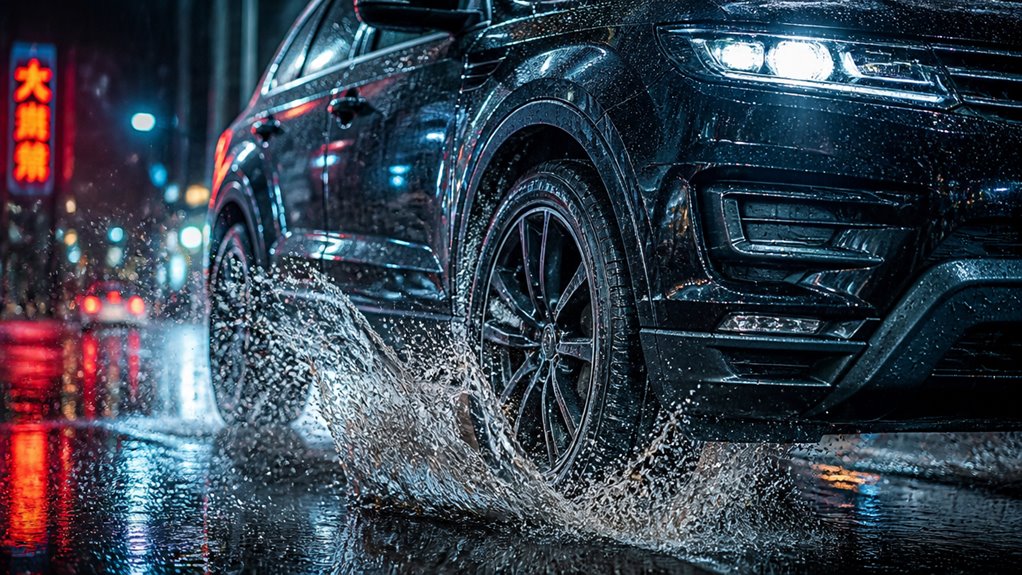
AWD helps you gain better traction in rain by distributing power to all four wheels. This reduces wheelspin during acceleration and improves stability on slippery surfaces.
However, it won’t prevent hydroplaning since traction depends on tire contact, not power delivery. AWD also doesn’t enhance braking, as stopping relies on tire grip and brakes.
Your tires play a more critical role in wet performance, and understanding how AWD compares with other drivetrains reveals where it truly benefits you most.
Key Takeaways
- AWD improves traction by distributing power to all four wheels, reducing wheelspin on wet roads during acceleration.
- AWD uses torque vectoring to allocate power to wheels with better grip, enhancing stability in rainy conditions.
- AWD does not prevent hydroplaning since it cannot maintain tire contact once tires lift off the pavement.
- Braking performance on wet roads is not enhanced by AWD; tire grip and brake systems are critical for stopping safely.
- Proper tire tread depth and pressure play a larger role than AWD in maintaining traction and preventing skidding in rain.
How AWD Improves Traction in Rain?

Although wet roads reduce tire grip, AWD improves traction by distributing power to all four wheels. This enhances forward momentum on slippery surfaces.
When accelerating from a stop or merging in heavy rain, AWD minimizes wheelspin by actively allocating torque to wheels with better grip. This torque vectoring maintains more consistent tire-road contact, optimizing friction forces.
You’ll notice improved traction particularly on slick or uneven wet pavement, where individual wheel slip is common. However, AWD’s benefits depend on the tires maintaining sufficient contact patches with the road.
It doesn’t increase the inherent friction coefficient but better manages power delivery. This enhanced traction boosts driver confidence by reducing unexpected loss of drive force.
It allows smoother acceleration and more controlled vehicle dynamics in wet conditions. Proper tire maintenance, including tire pressure and tread condition, is essential to maximize AWD performance in rain.
Why AWD Can’t Prevent Hydroplaning?
Even when AWD delivers power to all four wheels, it can’t stop your tires from losing contact with the road during hydroplaning. Hydroplaning happens when a layer of water builds between your tires and the road surface, lifting your tires off the pavement.
Since traction depends entirely on tire-road contact, AWD’s distribution of power becomes irrelevant once hydroplaning starts. The drivetrain can’t generate grip if the tires aren’t physically touching the road.
Factors like tire tread depth and water evacuation capabilities have a far greater role in preventing hydroplaning. AWD also doesn’t reduce the time or distance needed to regain control after hydroplaning begins.
Why AWD Doesn’t Improve Braking in Rain?
When you brake on wet pavement, AWD doesn’t enhance your stopping power because it primarily affects how power is delivered during acceleration. It doesn’t influence how tires grip during deceleration.
AWD improves acceleration power delivery but does not affect tire grip or stopping power during braking.
Braking relies on tire-road friction and the vehicle’s brake system, neither of which AWD affects. AWD doesn’t increase the coefficient of friction between tires and the slick surface, so it can’t shorten stopping distances in rain.
Instead, anti-lock braking systems (ABS) and electronic stability control play a more critical role by preventing wheel lock and maintaining directional control. Regardless of drivetrain, the effectiveness of braking depends on tire condition, brake performance, and road surface texture.
You must maintain a safe following distance and drive cautiously, as AWD offers no advantage in improving braking grip or reducing hydroplaning risk during wet stops.
Proper tire maintenance and ensuring weather conditions are suitable can further enhance safety during rain.
Why Your Tires Matter More Than AWD in Rain?
Beyond drivetrain type, your tires play the most critical role in maintaining traction on wet roads. Their tread pattern, depth, and rubber compound directly influence water evacuation and grip.
Worn or improperly inflated tires reduce the tire’s contact patch, increasing hydroplaning risk and decreasing wet traction. Even the best AWD system can’t compensate for tires that fail to maintain road contact.
Proper tread depth channels water away, preventing the tire from lifting off the pavement. Tires with optimized grooves and sipes enhance grip by breaking water’s suction effect.
Maintaining correct tire pressure guarantees consistent contact pressure distribution, improving stability. In wet conditions, your tire quality and maintenance dictate safety far more than AWD capabilities.
Choosing tires with reinforced sidewalls and adaptable rubber compounds ensures durability and reliable traction on wet, icy, and dry surfaces, further enhancing safety in rainy conditions.
This makes tire care essential for effective traction and control during rain.
How Front-Wheel Drive Performs in Rain vs. AWD?
Frequently, front-wheel drive (FWD) offers reliable traction in rainy conditions by placing the engine’s weight directly over the driven wheels. This enhances grip on wet pavement, improving tire contact and reducing wheelspin during acceleration compared to rear-wheel drive.
However, unlike AWD, FWD only powers two wheels, limiting traction benefits on slick surfaces or uneven wet roads.
Consider these FWD characteristics:
- Efficient power delivery to front tires aids stability in typical rain.
- Predictable handling and reduced oversteer risk improve driver control.
- Lower complexity and cost compared to AWD systems.
While AWD distributes power to all wheels for extra traction, FWD remains practical for most wet-weather driving. It balances performance, efficiency, and cost without significant compromises under regular rainy conditions. Additionally, selecting the right traction system plays a crucial role in maximizing safety and performance in wet environments.
When AWD Helps Most in Rainy Conditions?
While front-wheel drive handles most rainy conditions effectively, all-wheel drive offers specific advantages in more demanding wet scenarios.
AWD optimizes traction by distributing power to all four wheels, which proves essential during acceleration from a stop or merging on slick, wet surfaces.
You’ll notice the benefit most on poorly drained roads, heavy downpours, or uneven pavement where traction varies unpredictably.
AWD reduces wheelspin, enhancing stability and control when you’re pushing power through wet intersections or mildly flooded areas.
However, AWD doesn’t improve braking or prevent hydroplaning; those depend more on tire condition and driver input.
Selecting tires with water evacuation efficiency and advanced tread compounds is critical to complement AWD performance in rain.
Frequently Asked Questions
Does AWD Affect Fuel Efficiency in Rainy Conditions?
AWD generally decreases fuel efficiency regardless of weather, including rain, because it powers all four wheels, increasing mechanical drag and energy use.
While wet conditions might require more cautious acceleration, AWD’s extra traction doesn’t improve fuel economy.
You’ll still consume more fuel compared to FWD or RWD vehicles.
Efficient driving habits and tire maintenance matter more for fuel savings in rain than AWD presence.
Can AWD Systems Vary in Effectiveness Between Car Brands?
You’d think all AWD systems are cut from the same cloth, but they actually vary quite a bit between car brands. Different manufacturers use unique torque distribution methods, electronic controls, and hardware setups, affecting traction and responsiveness.
Some excel in quick power shifts, while others prioritize fuel efficiency. So, you can’t assume all AWDs perform equally in wet conditions; it’s a tech matter, not just a badge.
How Does AWD Interact With Electronic Stability Control in Rain?
AWD works synergistically with electronic stability control (ESC) in rain by distributing torque to all wheels while ESC monitors wheel slip and vehicle yaw.
When you accelerate on wet roads, AWD improves traction. ESC fine-tunes power delivery and applies brakes to individual wheels to maintain stability.
You’ll notice enhanced control during cornering or sudden maneuvers. ESC compensates for oversteer or understeer, maximizing AWD’s traction benefits in slippery conditions.
Is AWD Beneficial for Driving on Snowy or Icy Roads?
You might think AWD guarantees safe driving on snow or ice, but it only improves traction during acceleration by sending power to all wheels.
However, AWD doesn’t enhance braking or prevent slipping on icy patches.
Tire quality and cautious driving remain critical.
AWD helps you move forward confidently, yet it won’t stop you sooner or avoid sliding.
You must rely on good tires, steady control, and reduced speeds for safety on slippery roads.
What Maintenance Does an AWD System Require for Optimal Rain Performance?
You need to regularly inspect and change AWD system fluids, including differential and transfer case oils, to guarantee smooth power distribution.
Check for leaks, worn seals, and damaged components like driveshafts or CV joints.
Maintain proper tire condition and matching tread depth on all four wheels to optimize traction balance.
Keep your AWD software updated if applicable and follow manufacturer service intervals strictly to prevent mechanical wear that could impair wet-road performance.
Maximize Safety: Why Does AWD Help in Rain but Tires Are Key
While AWD improves traction by distributing power to all wheels, it doesn’t prevent hydroplaning or enhance braking in rain. Your tires play a more critical role in maintaining grip and control.
For instance, imagine driving through a flooded street: AWD helps you start moving, but if your tires lack tread, you’ll still lose control.
So, rely on AWD for stability, but prioritize quality tires and cautious driving in wet conditions.


