
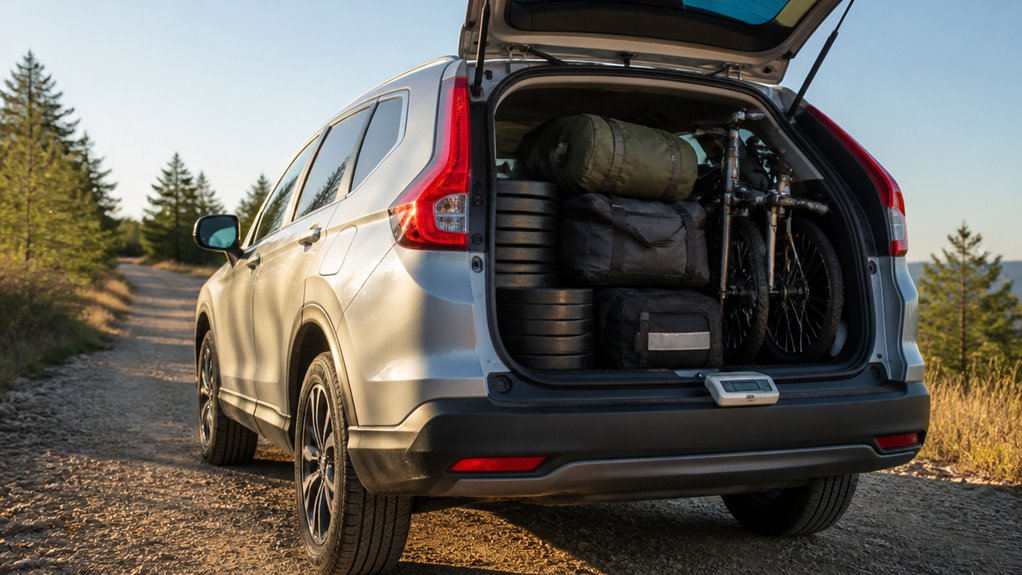
You can carry up to about 850 pounds of combined occupants, cargo, accessories, and trailer tongue load in a Honda CR-V, depending on your specific model and trim.
This limit is detailed on the driver’s doorjamb label, which accounts for safety and structural constraints.
Keep in mind, towing reduces your available payload since trailer tongue weight subtracts from this total.
Knowing these figures precisely helps you maintain safe handling and vehicle integrity.
Additional insights explain how configurations and loads affect your CR-V’s limits.
Key Takeaways
- The 2025 Honda CR-V has a maximum payload capacity of approximately 850 pounds (385 kg).
- Payload includes occupants, cargo, accessories, and trailer tongue load combined, not just cargo weight.
- Exact payload limits vary by model, trim, and powertrain and are listed on the driver’s doorjamb Tire and Loading Information label.
- Subtract occupant weight and trailer tongue load from the maximum payload to determine remaining cargo capacity.
- Exceeding payload limits risks safety, handling, and mechanical damage, so always verify GVWR, GAWR, and tire load ratings.
What Honda Means by CR-V Payload Capacity?

Understanding what Honda means by CR-V payload capacity starts with recognizing it as the total allowable weight of occupants, cargo, accessories, and any trailer tongue load combined, not just the cargo alone.
For the 2025 CR-V, the owner’s manual specifies a maximum payload of 850 pounds (385 kg). This figure varies by model year, trim, drivetrain, and equipment. You must consult the driver-doorjamb Tire and Loading Information label for exact limits.
To determine cargo allowance, subtract occupant weight from the maximum payload. For example, with 600 pounds of occupants, you have 250 pounds left for cargo and accessories.
It is important to remember that the tongue weight should be about 10% of the total trailer weight to maintain vehicle stability and safety.
How to Find Your CR-V’s Exact Payload and Weight Limits?
To figure out your CR-V’s exact payload and weight limits, begin by checking out the Tire and Loading Information label. You’ll find it on the driver-side doorjamb. This label gives you the specific maximum payload and weight limits for your vehicle, which is super handy.
Next, you’ll want to accurately calculate the combined weight of everyone onboard. Once you have that number, just subtract it from what the label states as the maximum load. This way, you can ensure you’re staying within safe operational limits that are tailored to your particular model, trim, and equipment.
It’s a straightforward process that helps keep your ride safe and enjoyable! Always consult your owner’s manual or official documentation to verify exact vehicle specifications for your CR-V model.
Locate Doorjamb Label
To find your CR-V’s exact payload and weight limits, look for the Tire and Loading Information label located on the driver’s doorjamb.
This label provides the maximum combined weight of occupants and cargo your specific vehicle can safely carry, reflecting variations by model year, trim, and equipment.
It also lists the Gross Vehicle Weight Rating (GVWR) and Gross Axle Weight Ratings (GAWR), essential for ensuring you don’t exceed axle or overall vehicle limits.
Use this label to determine your allowed payload by subtracting occupant weight from the total stated limit.
Remember, this label represents weight limits, not cargo space volume, so rely on it for safe loading rather than physical capacity.
Always consult this doorjamb label first before loading your CR-V to maintain handling and safety compliance.
Keep in mind that payload capacity can vary significantly depending on the trim and powertrain configuration of your vehicle.
Calculate Occupant Weight
Calculate the combined weight of all occupants before loading cargo in your CR-V to accurately determine available payload capacity.
Start by weighing each passenger or using reliable estimates, then sum their weights.
Next, locate the Tire and Loading Information label on the driver’s doorjamb, which specifies your vehicle’s maximum combined occupant and cargo load, often about 850 lb for recent models.
Subtract the total occupant weight from this maximum to find the remaining payload allowance for cargo, accessories, and trailer tongue load.
Remember, this label reflects the precise limit for your specific CR-V, accounting for model year and trim variations.
Always verify both the gross vehicle weight rating (GVWR) and axle ratings to make sure you don’t exceed safe loading thresholds.
This analytical approach prevents overloading and keeps vehicle stability and safety.
For enhanced comfort and safety during your trips, consider the impact of cabin air filter efficiency on interior air quality while loading your vehicle.
How Occupants, Cargo & Trailer Tongue Load Impact CR-V Capacity?
To figure out the total occupant weight accurately, it’s important to know how that impacts your remaining payload capacity for cargo and accessories.
So, keep in mind that the trailer tongue load also adds to the overall weight. This means it reduces the amount you can safely carry inside the vehicle.
When you’re checking the doorjamb label for the maximum allowable vehicle load, make sure to subtract both the occupant weight and the tongue load.
That way, you can avoid exceeding the CR-V’s safe carrying capacity. It’s all about keeping your ride safe and enjoyable!
Additionally, maintaining proper thermal management of your vehicle’s components is crucial when carrying heavy loads to prevent overheating and ensure safety.
Occupant Weight Calculation
When determining how much cargo your Honda CR-V can safely carry, start by accounting for the combined weight of all occupants.
The vehicle’s maximum load, found on the doorjamb label, includes occupants, cargo, and accessories but excludes trailer tongue load for this calculation.
Subtract occupant weight from the total payload limit to find your remaining cargo capacity. This step is critical to avoid exceeding the Gross Vehicle Weight Rating (GVWR) or axle load limits, which can impair vehicle control and safety.
It is equally important to use engine oil that meets the exact OEM specifications to maintain vehicle performance and warranty compliance.
| Factor | Impact on Payload Capacity |
|---|---|
| Maximum Load Limit | Total allowed weight (e.g., 850 lb) |
| Occupant Weight | Subtracted from max load |
| Remaining Cargo Limit | Max load minus occupant weight |
| Accessories Weight | Also subtracted from max load |
Accurately calculating occupant weight guarantees you maintain safe loading within CR-V limits.
Trailer Tongue Load Effects
Although towing adds utility to your Honda CR-V, the trailer tongue load directly reduces the available payload capacity for occupants and cargo.
The maximum load stated on your vehicle’s doorjamb label, typically around 850 lb for recent models, includes occupants, cargo, accessories, and the tongue load.
When you hitch a trailer, its tongue weight subtracts from that total, leaving less capacity for passengers and gear.
For example, if your combined occupant weight is 600 lb and the tongue load is 100 lb, only 150 lb remain for cargo and accessories.
Exceeding these limits risks surpassing GVWR and GAWR ratings, compromising vehicle stability and safety.
Always verify your CR-V’s exact payload limits on the label and recalculate available capacity when trailer tongue or occupant loads change.
Proper maintenance of your vehicle’s undercarriage with corrosion protection can help ensure that weight capacity and safety ratings remain reliable over time.
Why CR-V Cargo Volume Isn’t the Same as Weight Capacity?
Even if your CR-V’s cargo area appears spacious enough to hold a heavy load, the cubic-foot volume doesn’t indicate how much weight the vehicle can safely carry.
Cargo volume measures space, not weight capacity, which depends on structural limits and safety factors. You must consider these points:
- Payload capacity includes occupants, cargo, accessories, and trailer tongue load, not just cargo weight.
- The maximum allowable load is specified on the driver’s doorjamb label and varies by model, trim, and equipment.
- Exceeding weight limits, even within cargo volume, can impair handling, stability, and cause mechanical stress.
- Consistently overloading the vehicle can accelerate metal fatigue and increase the risk of axle damage.
How CR-V Models and Trims Affect Payload and Towing Ratings?
Because CR-V payload and towing capacities depend heavily on model year, trim level, and drivetrain, you need to consult your specific vehicle’s doorjamb label and owner’s manual for exact ratings.
For instance, 2026 gasoline trims typically have a towing capacity up to 1,500 lb, while hybrids rate around 1,000 lb.
Payload limits, including occupants and cargo, vary accordingly, with maximum loads near 850 lb on some models but differing by configuration.
Curb weights range from about 3,472 to 3,926 lb, affecting allowable payload.
Changes in drivetrain or added equipment also influence GVWR and GAWR, which you must observe alongside tire-load limits.
Ignoring these specifics risks overloading, which compromises safety and handling.
Always use the exact data for your CR-V’s trim and market to determine safe payload and towing limits.
Upgrading to load-leveling shocks can help maintain vehicle stability and handling when approaching maximum payload or towing capacities.
CR-V Towing Limits and Their Impact on Payload Capacity
When you tow with your Honda CR-V, the trailer tongue load directly reduces the available payload capacity for occupants and cargo. The vehicle’s maximum load rating, often around 850 lb, includes occupants, cargo, accessories, and the tongue load combined.
Towing with your Honda CR-V reduces payload capacity as the tongue load counts toward the total vehicle load.
To manage your payload effectively, consider these points:
- Confirm the tongue load weight and subtract it from your vehicle’s maximum payload to find remaining capacity for occupants and cargo.
- Verify the GVWR and GAWR ratings on your doorjamb label to guarantee total weight, including trailer tongue load, stays within limits.
- Recognize that towing capacity, up to 1,500 lb for gasoline trims, doesn’t increase payload capacity. Exceeding combined limits compromises safety and vehicle performance.
Understanding this interplay helps you avoid overloading your CR-V while towing. Proper maintenance, including using high-performance synthetic oil, can help ensure your engine withstands the added stress from towing and payload demands.
Tips to Avoid Overloading Your CR-V and Stay Safe
To avoid overloading your CR-V and maintain safe handling, you must carefully monitor the combined weight of occupants, cargo, accessories, and any trailer tongue load.
Begin by consulting the vehicle’s driver-doorjamb Tire and Loading Information label to identify your specific maximum load rating.
Accurately weigh occupants and subtract their total from the label’s limit to determine available cargo capacity.
Remember, trailer tongue load reduces this capacity, so factor it in precisely.
Distribute weight evenly to prevent exceeding GVWR and GAWR on either axle, ensuring stability and handling remain optimal.
Avoid relying on cargo volume measurements, as spatial fit doesn’t guarantee safe weight limits.
Regularly reassess load distribution and total weight when passenger count or cargo changes to maintain adherence to manufacturer specifications and maximize safety.
Frequently Asked Questions
What Tools Can Help Weigh My Cr-V’s Cargo Accurately?
You can use a portable digital luggage scale to weigh individual items before loading.
For total cargo weight, consider a vehicle scale at a truck stop or public weigh station to measure your Honda CR-V’s curb weight with and without cargo.
Subtracting these gives precise cargo weight.
Additionally, wheel load scales placed under each tire can help verify axle loads, ensuring you stay within safe payload limits and maintain vehicle stability.
How Does Weather Affect My Cr-V’s Payload Capacity?
Don’t expect your CR-V to haul a ton of bricks in a blizzard without consequences! Cold weather thickens fluids and stiffens tires, slightly reducing your payload capacity and vehicle performance.
Snow or ice on the roof adds hidden weight, and slippery roads demand cautious loading.
While the official payload rating stays the same, you should factor in weather’s subtle impact on handling and braking to keep your drive safe and stable.
Can Roof Racks Increase My Cr-V’s Total Load Limit?
Roof racks don’t increase your CR-V’s total load limit; they count toward the vehicle’s maximum payload.
You need to include the weight of the roof rack and its cargo when calculating the total load.
Exceeding the combined payload, which includes occupants, cargo, accessories, and trailer tongue load, risks safety and vehicle stability.
Always check your doorjamb label for the precise limit and factor in roof load to avoid overloading.
What Are Common Signs of an Overloaded CR-V While Driving?
You’ll notice handling feels sluggish, with delayed steering response and increased body roll during turns.
Your CR-V might sag visibly, especially in the rear, and braking distances will lengthen due to extra weight.
Uneven tire wear or excessive heat buildup can occur.
You might also hear unusual noises from the suspension or tires.
These signs indicate overloading, risking stability loss and potential mechanical damage.
Always check load limits to stay safe.
How Often Should I Check My Cr-V’s Tire Pressure When Loaded?
You should check your CR-V’s tire pressure at least weekly when loaded, and always before long trips.
Loading increases tire stress and heat, causing pressure changes. Use a reliable gauge to make sure pressures match the specifications on your doorjamb label, adjusting for the extra load.
Regular monitoring prevents uneven wear, blowouts, and compromised handling. Don’t rely solely on visual inspection; accurate pressure checks are essential for safety and performance.
Load Smarter, Tow Safer, Drive With Confidence
When you consider how your Honda CR-V’s payload capacity balances occupants, cargo, and towing limits, understanding these specifics keeps you safe and efficient.
Just as exceeding weight can strain the vehicle’s performance, knowing your exact limits guarantees peak handling and durability.
By precisely managing load distribution and adhering to model-specific ratings, you protect both your CR-V and yourself, turning technical knowledge into practical, everyday driving confidence.


