
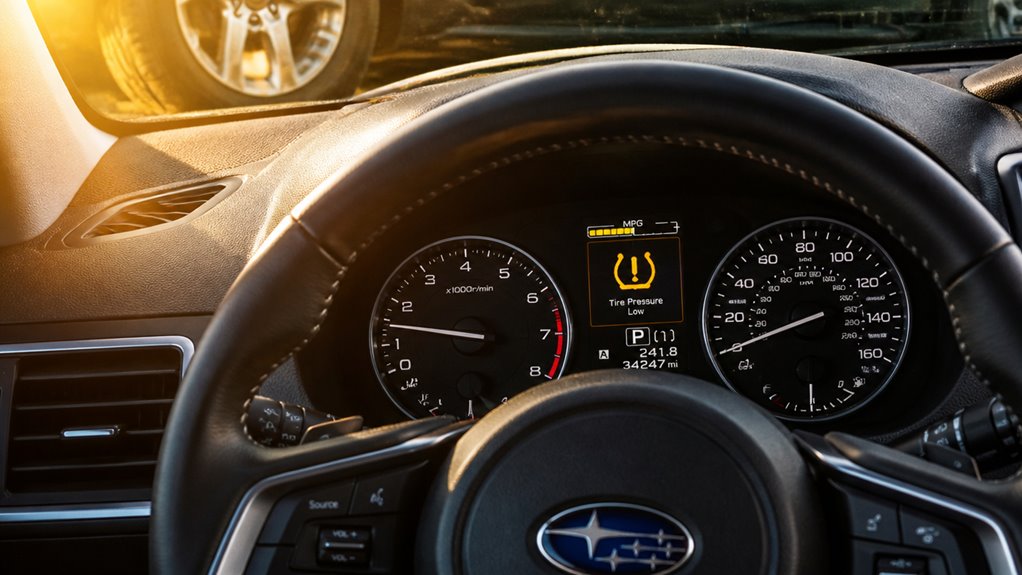
If your Subaru’s tire pressure light is on but tires look fine, it’s often due to subtle pressure drops from temperature changes or slow leaks not easily seen.
Faulty TPMS sensors, depleted batteries, or system faults can also trigger the warning. Always check pressures cold against the driver-door placard using a calibrated gauge.
Inspect valve stems for damage and attempt a reset by driving to recalibrate sensors. Understanding these causes helps you maintain accurate tire monitoring and safety.
Key Takeaways
- TPMS may trigger falsely due to faulty sensors, depleted sensor batteries, or electrical/system faults even if tire pressures are correct.
- Cold weather lowers tire pressure by 1–2 PSI per 10°F, causing temporary TPMS alerts despite tires appearing fine.
- Measure tire pressures cold with a calibrated gauge, comparing to driver-door placard values, not sidewall markings, to confirm true inflation.
- Recalibrate TPMS by inflating tires to placard PSI, then driving 10–15 minutes at 20–25 mph to reset sensor readings.
- Persistent TPMS warnings after verification suggest sensor or module issues requiring professional diagnostics at a Subaru service center.
Common Reasons the Subaru Tire Pressure Light Activates Without Visible Tire Issues
Although your Subaru’s tire pressure light may come on even when the tires look fine, several underlying causes can trigger this warning.
Underinflation is the primary reason; the TPMS alerts when pressure drops roughly 25% below the vehicle’s recommended PSI, found on the driver-door placard, not the tire sidewall.
Underinflation triggers the TPMS when tire pressure falls about 25% below the recommended PSI on the driver-door placard.
Slow leaks often evade visual detection but reduce pressure enough to activate the light. Additionally, some Subaru models monitor the spare tire, which can cause warnings if underinflated.
Faulty sensors, TPMS modules, or electrical issues may also falsely trigger the light despite correct pressures.
To diagnose, measure each tire’s cold pressure accurately with a reliable gauge, inspecting for valve stem damage or punctures.
This systematic approach helps isolate the precise cause behind the warning.
Sensor battery depletion is a common cause of false alerts, as TPMS sensors rely on sealed batteries that lose power over time, necessitating sensor replacement when drained.
How Temperature Changes Impact Subaru Tire Pressure Readings?
You might’ve noticed that the tire pressure in your Subaru seems to fluctuate with the temperature. Well, it’s pretty common for it to change by about 1–2 PSI for every 10°F drop in temperature. This can sometimes trigger the TPMS warning light, even if your tires are perfectly fine.
Seasonal changes, especially in the colder months, can lead to these pressure shifts and occasional false alerts. So, it’s a good idea to keep an eye on your tire pressure.
To keep everything running smoothly, make sure to check and adjust your tire pressure according to the driver-door placard whenever the temperature changes. This little habit can help you maintain accurate readings and avoid those pesky warnings!
Additionally, cold temperatures can cause metal components and seals to contract, which may affect tire pressure readings due to temperature-related component changes.
Temperature Effects On PSI
When temperatures drop, your Subaru’s tire pressure can decrease noticeably because cold air contracts. This reduces the volume inside the tire, lowering PSI enough to trigger the TPMS warning, even if the tires are physically fine.
Typically, every 10°F drop reduces tire pressure by about 1–2 PSI. Understanding this helps you interpret sudden alerts during cold spells.
| Temperature Change (°F) | Approximate PSI Change |
|---|---|
| +10 | +1 to +2 |
| 0 | Baseline |
| -10 | -1 to -2 |
Monitoring PSI in stable temperatures guarantees accurate readings. Always check pressure when tires are cold, as heat from driving can inflate readings. This can mask true pressure drops caused by temperature shifts. Maintaining proper tire pressure is essential because under-inflated tires increase rolling resistance and reduce fuel efficiency.
Seasonal Pressure Fluctuations
Understanding how seasonal temperature swings affect your Subaru’s tire pressure helps explain frequent TPMS alerts that seem to come and go.
As temperatures drop, air contracts inside tires, lowering PSI by approximately 1–2 PSI for every 10°F decrease. This natural contraction can trigger the TPMS warning if pressure falls below the placard’s recommended threshold, even though tires are structurally sound.
Conversely, rising temperatures expand air, increasing pressure, which may temporarily mask low-pressure conditions.
You should measure tire pressure when tires are cold, ideally before driving or after several hours of rest, to get accurate readings unaffected by heat.
Accounting for these fluctuations prevents unnecessary worry and guarantees you maintain peak inflation, preserving tire performance and safety throughout seasonal changes. Regularly checking tire pressure is essential to prevent exacerbating tire imbalance and to maintain smooth operation.
Checking Subaru Tires Against the Driver-Door Placard Pressure
First things first, you’ll want to find the driver-door placard on your Subaru. This little sticker holds the key to the recommended tire pressures for your vehicle. It’s super important to use these numbers as your reference.
Now, here’s a tip: always check your tire gauge readings against the placard values instead of the sidewall markings. The sidewall might show maximum pressure, but that’s not what you’re aiming for. You want the target pressure, which is what’s listed on the placard.
And don’t forget, for the most accurate results, measure your tire pressures when the tires are cold. This means checking them before you’ve driven anywhere. Once you have those readings, you can adjust the inflation as needed!
If the tire pressure light remains on despite correct pressures, it may indicate a problem with the tire pressure monitoring system that requires diagnostic attention.
Locate Driver-Door Placard
To accurately check your Subaru tire pressures, locate the driver-door placard, which provides the manufacturer’s recommended PSI for your specific vehicle model.
Open the driver’s side door and look for a white or silver sticker affixed to the door jamb or the edge of the door itself.
This placard details the ideal cold tire pressures for front, rear, and sometimes the spare tire.
It also includes vehicle load and tire size information critical for accurate inflation.
Avoid relying on the tire sidewall pressure rating, as that number represents the maximum pressure, not the recommended operating pressure.
Use the placard’s PSI values as your reference when measuring and adjusting tire pressure to guarantee the TPMS functions correctly and maintains vehicle safety and performance.
Compare Tire Pressure Values
Once you’ve located the driver-door placard, the next step involves comparing each tire’s cold pressure reading directly against the specified PSI values listed there. This guarantees you’re matching the vehicle manufacturer’s recommended inflation, not the tire’s maximum pressure molded on the sidewall.
Use a reliable gauge to check all four tires and the spare if equipped. Note any deviations that might trigger the TPMS warning.
| Tire Position | Measured PSI | Placard PSI |
|---|---|---|
| Front Left | 33 | 35 |
| Front Right | 35 | 35 |
| Rear Left | 34 | 33 |
| Rear Right | 32 | 33 |
| Spare | 40 | 60 |
Correct any underinflated tires to the placard PSI for accurate monitoring. For persistent warning lights, consider checking for issues related to sensor compatibility that may affect the system’s accuracy.
Use Cold Tire Readings
Regularly checking tire pressure when the tires are cold is essential for accurate readings that reflect true inflation levels. Cold tires mean the vehicle has been stationary for at least three hours or driven less than a mile at low speed.
Heat from driving increases tire pressure, causing false high readings that can mask underinflation or trigger the TPMS light incorrectly. Always compare your readings to the driver-door placard, not the tire sidewall, since placard PSI matches Subaru’s recommended inflation.
Use a calibrated gauge to measure each tire and the spare if equipped. Adjust pressure accordingly, then recheck after the tires have cooled again. This process guarantees the TPMS system detects accurate pressure values, reducing false warnings and maintaining peak tire performance and safety. For convenient and precise measurements, consider using a portable air compressor with a digital pressure gauge and auto shutoff feature.
Inspecting Tires and Valve Stems for Slow Leaks or Damage
Keep an eye out for subtle signs of slow leaks or damage by closely examining your tires and valve stems.
Regularly inspect your tires and valve stems for subtle signs of slow leaks or damage.
Inspect the valve stem for cracks, corrosion, or looseness, as these can cause gradual air loss.
Apply soapy water to the valve stem, bead area, and tread surface; bubbles indicate escaping air.
Look carefully for embedded nails, cuts, or punctures that mightn’t be immediately visible.
Listen for any hissing sounds near the valve or tire surface, signaling leaks.
Monitor tire pressure over several days to detect uneven drops, which suggest a slow leak.
Pay special attention to the bead seal where the tire meets the rim, since small leaks often originate there.
Address confirmed leaks promptly with professional repair or replacement to maintain accurate tire pressure and avoid triggering the warning light.
Regular inspection and cleaning of the tire surface can prevent tar buildup that may damage the tire and affect pressure retention.
When and How to Reset the Subaru Tire Pressure Light?
Resetting the Subaru tire pressure light often involves driving at moderate speeds to allow the system to recalibrate automatically.
Typically, you should drive at 20–25 mph or faster for 10 to 15 minutes after inflating tires to the exact placard PSI when cold.
This lets the TPMS sensors update and clear the warning if pressures are correct.
If the light remains on, consult your owner’s manual for a manual reset procedure, which may use a dashboard button or specific sequence.
Some models require inflating tires slightly above the recommended PSI before returning to normal to trigger sensor relearn.
Should the warning persist despite proper inflation and driving, use a TPMS diagnostic tool or visit a service center to check for sensor or module faults.
Additionally, consulting the owner’s manual can provide important maintenance procedures and troubleshooting steps relevant to the tire pressure monitoring system.
Using Soapy Water and Other Simple Methods to Find Hidden Tire Leaks
To track down hidden tire leaks, start by spraying soapy water on the valve stem, bead area, and tire surface.
Look carefully for bubbles forming, as they pinpoint escaping air. Focus on the valve stem base and bead seal, where leaks often hide and aren’t immediately visible.
Next, listen closely for hissing sounds near these areas, which can confirm a slow leak.
Monitor tire pressure over several days using a reliable gauge to identify any tire losing air faster than the others.
If you detect persistent pressure drops or visible bubbling, the leak likely needs professional repair or component replacement.
These simple methods offer a practical way to detect leaks that aren’t obvious, helping you rule out hidden tire issues before exploring sensor or electrical faults.
Remember that pressure changes and external forces can also affect tire pressure readings and may contribute to false alerts on your tire pressure monitoring system.
How to Spot Faulty Subaru TPMS Sensors and Electrical Problems?
When your Subaru’s tire pressure light stays on despite correct inflation and no visible leaks, you need to dig into potential TPMS sensor or electrical faults.
Start by scanning for diagnostic trouble codes using an OBDII TPMS tool. Error codes can pinpoint a faulty sensor or module.
Inspect each sensor for physical damage or corrosion at the valve stem. Check the sensor battery life; most last 5-10 years but may fail prematurely.
Electrical issues might involve the TPMS control module or wiring harness. Look for loose connections or damaged wires.
If the system doesn’t reset after recalibration drives, suspect sensor malfunction or a communication fault with the ECU.
In persistent cases, professional diagnostics at a Subaru service center are advisable to confirm accurate pressure monitoring and system integrity.
Why the Subaru Tire Pressure Light Stays On After Reset?
Even after you’ve correctly inflated your tires and followed the recommended reset procedure, the Subaru tire pressure light can remain illuminated due to several underlying factors. Understanding these can help you troubleshoot effectively:
- Slow leaks or temperature changes may cause pressure drops unnoticed during quick checks, keeping the system alert even after reset.
- Sensor or module faults can cause false warnings; a malfunctioning TPMS sensor or ECU mightn’t register the reset properly.
- Incomplete reset procedure or driving conditions: some Subaru models require driving above 25 mph for 10–15 minutes or a manual reset via dashboard controls to fully clear the warning.
If the light stays on despite correct inflation and reset, it indicates the system hasn’t acknowledged the new pressure state or has an internal fault.
When to Visit a Subaru Service Center or Tire Shop for TPMS Issues?
If your Subaru’s tire pressure light remains illuminated despite verifying correct inflation and performing recommended reset procedures, it’s time to seek professional assistance.
Persistent warnings often point to sensor failure, TPMS module faults, or ECU communication issues that require diagnostic scanning.
Visit a Subaru service center or tire shop if the light won’t clear after confirming all tires—including the spare—match placard PSI when cold.
Professionals can perform a TPMS relearn sequence, inspect valve stems and sensors, and use OBDII diagnostic tools to read trouble codes.
Additionally, if you detect slow leaks or the system fails to recalibrate after driving at recommended speeds, a shop inspection is essential to prevent inaccurate monitoring and guarantee your TPMS functions reliably for safe driving.
Frequently Asked Questions
Can Using Different Tire Brands Affect Subaru TPMS Accuracy?
Yes, using different tire brands can affect your Subaru TPMS accuracy.
Variations in tire construction, sidewall stiffness, and rolling circumference influence pressure readings and sensor calibration.
Even slight size differences can cause the system to misinterpret pressure levels, triggering warnings.
To maintain accurate TPMS function, you should use tires matching Subaru’s specifications and ensure all sensors are properly relearned after installation or rotation.
How Often Should Subaru TPMS Sensors Be Replaced?
You should replace Subaru TPMS sensors roughly every 5 to 10 years or when the sensor battery fails, as these batteries are sealed and non-replaceable.
If your TPMS light stays on despite correct tire pressure or if a diagnostic scan indicates sensor malfunction, replacement is necessary.
Also, replace sensors when installing new tires or if physical damage occurs.
Regularly check sensor functionality during tire service to maintain accurate pressure monitoring.
Does Seasonal Tire Rotation Require TPMS Recalibration?
Yes, seasonal tire rotation on your Subaru often requires TPMS recalibration.
When you switch tires between front and rear or remove and reinstall them, the system may not recognize sensor positions correctly.
After rotation, drive at 20–25 mph for 10–15 minutes to allow automatic relearn.
If the light stays on, you’ll need to perform a manual TPMS reset using the dashboard controls or a diagnostic tool to ensure accurate pressure monitoring.
Can Aftermarket Wheels Interfere With Subaru TPMS Function?
Aftermarket wheels can be like a puzzle piece that doesn’t quite fit your Subaru’s TPMS system. If the wheels lack proper sensor compatibility or the sensors aren’t correctly installed, the TPMS might lose its “voice,” causing false warnings or no readings at all.
You’ll need to make sure the sensors match the Subaru’s system and properly program them. Otherwise, your tire pressure monitoring won’t function accurately, risking safety and compliance issues.
What Battery Type Do Subaru TPMS Sensors Use?
Subaru TPMS sensors typically use a small lithium coin cell battery, usually a CR2032 or equivalent.
This battery type provides long-lasting power, often 5 to 10 years, depending on usage and conditions.
You can’t replace these batteries easily, as most TPMS sensors are sealed units.
When the battery dies, the entire sensor usually requires replacement to maintain accurate tire pressure monitoring and proper system function.
Maximize Your Solar Light’s Performance by Choosing the Right On/Off Switch Feature
Think of your Subaru’s tire pressure light like a smoke alarm. It might beep even without a fire, signaling a hidden issue.
Just as a smoke alarm detects invisible smoke particles, your TPMS senses subtle pressure changes or sensor glitches that your eyes can’t catch.
By systematically checking temperature effects, valve stems, and sensor health, you guarantee accurate readings.
If the light stays on, don’t ignore it. Professional diagnostics can prevent bigger problems down the road.


