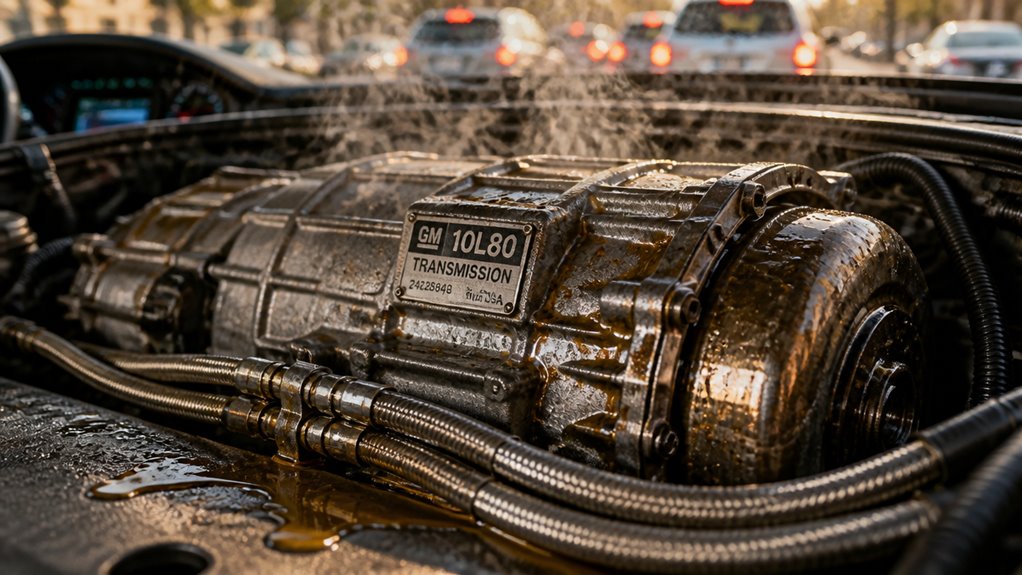
If your GM 10L80 transmission heats up in traffic, it’s likely due to restricted fluid flow caused by a thermal bypass valve that opens late. This limits cooler circulation until high temps occur.
Damaged or kinked cooler lines further reduce cooling efficiency, causing heat buildup during stop-and-go driving. Elevated fluid temperatures accelerate wear and risk failure.
Understanding how the thermal bypass valve and cooler lines interact can help you pinpoint and fix these overheating issues effectively.
Key Takeaways
- The 10L80’s thermal bypass valve (TBV) delays cooler circulation until ~143°F, causing heat buildup in stop-and-go traffic.
- Twisted or damaged cooler lines restrict fluid flow, increasing transmission temperature during low-speed driving.
- Reduced airflow over the auxiliary cooler at idle or low speeds limits heat dissipation, raising transmission temperature.
- Degraded transmission fluid accelerates overheating and wear under extended high-temperature conditions.
- Replacing the TBV with updated versions that open earlier often resolves overheating issues in traffic.
Why GM 10L80 Transmissions Overheat (And How to Fix It)?
Although the GM 10L80 transmission is engineered for durability, it can overheat in traffic due to specific design and operational factors.
One primary cause is the thermal bypass valve, which restricts fluid flow to the cooler until about 143°F (61°C) is reached. This delays cooling during stop-and-go conditions.
The thermal bypass valve limits fluid cooling until 143°F, delaying heat reduction in stop-and-go traffic.
If the valve remains closed too long, fluid temperatures rise rapidly. Additionally, you should inspect cooler lines for twists or damage that restrict fluid flow. Reduced airflow in traffic magnifies this effect.
Diagnosing involves comparing pan and cooler-line temperatures. A significant gap suggests bypass valve or cooler-line issues.
Fixes include replacing the thermal bypass valve with updated versions that open earlier. Repairing or replacing deformed cooler lines can restore proper fluid circulation and reduce heat buildup.
Consistently high transmission temperature risks further component damage and underscores the need for proper fluid maintenance and inspection of transmission cooling systems.
Warning Signs Your 10L80 Transmission Is Running Too Hot
You’ll often notice specific symptoms that indicate your GM 10L80 transmission is running too hot, signaling potential overheating issues. Common warning signs include harsh or delayed shifting, transmission temperature warnings, and burnt-smelling fluid.
Monitoring temperature differences between the transmission pan and cooler lines can reveal malfunctioning thermal bypass valves or cooler-line restrictions.
| Symptom | Possible Cause |
|---|---|
| Harsh or delayed shifting | Excessive fluid temperatures |
| Burnt-smelling fluid | Fluid degradation from heat |
| Temperature warning light | Overheating detection by TCM |
| Cooler-line temp low | Bypass valve or line restriction |
Recognizing these signs early helps you address overheating before it leads to transmission wear or failure. Maintaining proper transmission fluid levels is essential to avoid overheating and extend transmission life.
How Stop-And-Go Traffic Raises GM 10L80 Transmission Heat?
Stop-and-go traffic markedly increases the heat load on your GM 10L80 transmission by limiting fluid circulation and reducing cooler airflow.
Stop-and-go traffic significantly raises heat stress on your GM 10L80 by restricting fluid flow and airflow.
When you operate at low speeds or idle frequently, the transmission fluid moves slower through the cooler circuit, restricting heat dissipation.
Additionally, the auxiliary cooler relies on vehicle speed to draw air, so the reduced airflow in traffic further hampers heat transfer.
This combination raises transmission temperatures, especially during extended periods of stop-and-go driving.
You’ll notice that fluid heat accumulates because the cooler can’t efficiently shed heat without sufficient fluid movement or airflow.
Consequently, the transmission’s thermal load intensifies, increasing the risk of reaching critical temperature thresholds that contribute to accelerated wear and potential overheating warnings.
Extended high temperatures can cause thermal breakdown of transmission fluid, further degrading lubrication and shifting performance.
Thermal Bypass Valve’s Role in 10L80 Transmission Overheating
When the thermal bypass valve in your GM 10L80 transmission remains closed longer than intended, it delays fluid flow to the cooler. This causes internal temperatures to rise, especially in low-speed traffic.
This valve opens around 143°F (61°C) to allow fluid cooling. If it stays closed past this point, heat accumulates rapidly. You’ll notice a temperature gap between the pan and cooler-line readings, signaling restricted cooling.
Regular maintenance, including fluid level checks and condition assessment, is crucial to prevent overheating and ensure proper transmission function.
| Parameter | Normal Range | Effect When Faulty |
|---|---|---|
| Bypass Valve Opening | ~143°F (61°C) | Delayed cooler fluid flow |
| Pan Temperature | 206°F to 215°F | Elevated heat buildup |
| Cooler-Line Temperature | Close to pan temp | Lower than pan when stuck |
Understanding this valve’s behavior helps you assess overheating causes accurately.
Identifying Faulty Thermal Bypass Valve in 10L80 Transmissions
Hey there! So, let’s talk about the thermal bypass valve in your 10L80 transmission. This little component plays a crucial role in controlling fluid flow to the cooler. It usually keeps things in check until the transmission fluid hits around 143°F. By doing this, it helps prevent premature cooling, which is pretty important.
Now, if you’re noticing a significant temperature difference—like the pan being much hotter than the cooler line—that’s a red flag. It could mean that the valve is stuck closed for too long. In that case, you might want to consider replacing it with an updated version that opens earlier. Doing so can help reduce heat buildup and really boost your transmission’s cooling efficiency.
Regular maintenance and inspection of critical components like this can help avoid overheating risks and prolong transmission life.
Thermal Bypass Valve Function
Although the thermal bypass valve (TBV) in GM 10L80 transmissions plays an essential role in regulating fluid flow to the cooler, it can cause overheating if it fails to open at the correct temperature.
The TBV remains closed until transmission fluid reaches about 143°F (61°C), directing fluid internally to speed warm-up. If it stays closed too long, fluid circulation to the cooler is delayed, raising temperatures during low-speed or stop-and-go traffic.
You can identify a faulty TBV by comparing transmission pan and cooler-line temperatures. A notable gap suggests restricted cooler flow.
Key points about TBV function:
- Maintains fluid temperature by bypassing cooler until set point (~143°F)
- Delayed opening causes elevated fluid temperatures in traffic
- Diagnostic temperature gaps between pan and cooler lines indicate malfunction
- Replacing TBV often resolves overheating complaints
Additionally, improper warm-up due to delayed fluid circulation can increase mechanical stress and reduce transmission efficiency, underscoring the importance of proper system warm-up.
Temperature Gap Indicators
Detecting a faulty thermal bypass valve (TBV) hinges on monitoring temperature differences between the transmission pan and cooler lines.
You want to measure these with an infrared thermometer or scan tool data. Normally, the cooler-line temperature rises closely with the pan temperature once the TBV opens, allowing fluid flow to the auxiliary cooler.
If you see a consistent gap of about 10°F to 15°F or more, where the pan temperature exceeds the cooler-line temperature, that suggests the TBV is staying closed too long.
This delayed opening restricts fluid circulation, causing higher transmission temperature in traffic. Keep in mind, if both cooler-line and pan temperatures rise above engine coolant temperature, you should also inspect for cooler-line restrictions or airflow issues before concluding a TBV fault.
Using a reliable OBD2 scanner with live data monitoring can help track these temperature readings accurately for effective diagnostics.
Valve Replacement Benefits
Replacing a faulty thermal bypass valve (TBV) in 10L80 transmissions directly addresses delayed fluid circulation that causes overheating in traffic.
When the TBV fails to open at the designed temperature, fluid bypasses the cooler, raising transmission heat during low-speed, stop-and-go conditions.
By swapping in an updated valve that opens earlier, you restore consistent cooler flow, reducing temperature spikes and protecting internal components.
Key benefits include:
Improved thermal management, lowering transmission fluid temperature by enabling earlier cooler engagement.
Reduced risk of heat soak that accelerates fluid degradation and wear.
Enhanced shift quality and responsiveness by maintaining peak fluid viscosity.
Prevention of error codes linked to temperature irregularities and cooler-line flow restrictions.
Replacing the TBV is a targeted, effective fix to mitigate overheating symptoms and extend transmission life.
Proper installation and regular maintenance ensure the thermal bypass valve’s longevity and consistent transmission performance.
How Cooler-Line Damage Raises GM 10L80 Transmission Temps?
When your cooler line gets twisted or restricted, it can really mess with the fluid flow to the auxiliary cooler. This is a big deal, especially when you’re stuck in stop-and-go traffic, because it can cause your transmission temperatures to rise.
You might even notice that the cooling efficiency takes a hit as the fluid has a tough time circulating properly through the system. Ensuring proper flow and avoiding restrictions is as important as maintaining durable materials to prevent damage and overheating.
Cooler Line Restrictions
Twisted or misshaped cooler lines can markedly restrict fluid flow to the auxiliary cooler in GM 10L80 transmissions. This causes elevated temperatures during low-speed driving or stop-and-go traffic.
When the cooler line is damaged or bent, it limits the volume of transmission fluid circulating through the cooler. This reduces heat dissipation, and the restriction becomes critical in traffic, where airflow is already limited.
You’ll often need to inspect underbody panels to assess line condition properly. If untwisting doesn’t restore the line’s shape, replacement is essential before rechecking fluid levels.
Key points to contemplate:
- Restricted lines impair fluid movement, elevating transmission temps.
- Damage often occurs from road debris or improper installation.
- Inspecting requires removal of underbody panels for access.
- Persistent deformation mandates line replacement to restore cooling.
Additionally, impaired fluid flow can cause a drop in hydraulic pressure, which may lead to sluggish shifting and increased transmission wear.
Impact On Fluid Flow
Restricted or misshaped cooler lines directly reduce the volume of transmission fluid flowing through the auxiliary cooler. This limits heat dissipation in the GM 10L80 transmission.
When cooler lines twist or deform, they create flow restrictions that impede fluid circulation. This is especially problematic at low speeds or in stop-and-go traffic, where natural airflow is already compromised.
Restricted flow causes heat to accumulate within the transmission, raising operating temperatures beyond normal ranges. You’ll notice higher pan temperatures while cooler-line temperatures lag, indicating poor fluid movement through the cooler.
Over time, this thermal buildup stresses internal components, accelerating wear. To restore proper fluid dynamics, inspect and correct any cooler-line damage, replacing lines that don’t return to their original shape.
This action guarantees adequate fluid volume reaches the cooler, maintaining peak transmission temperatures under traffic conditions.
Identifying and Fixing Cooler-Line Restrictions
Because cooler-line integrity directly affects fluid flow to the auxiliary cooler, you should carefully inspect these lines for kinks, twists, or deformation that could impede circulation.
Restricted or damaged cooler lines limit ATF flow, causing temperature spikes in stop-and-go traffic.
To accurately assess, remove underbody panels if needed to access the lines fully.
If you find persistent deformation after straightening, replace the affected line before proceeding.
Key steps include:
- Visually inspect for bends, kinks, and crushed sections.
- Check line routing to prevent contact with hot or moving parts.
- Confirm fittings and clamps are secure and leak-free.
- Use an infrared thermometer to compare cooler-line temps with pan temps for flow verification.
Addressing cooler-line restrictions restores proper cooling and reduces heat buildup effectively.
Diagnosing Temperature Differences in Your GM 10L80 Transmission
To kick things off, you’ll want to compare the temperatures of the transmission pan and the cooler lines. Grab a scan tool and an infrared thermometer for this—it’s a great way to spot any discrepancies. If you notice a significant temperature gap, it could mean that the thermal bypass valve isn’t opening like it should. This can really restrict fluid flow to the cooler.
After that, take a close look at the cooler lines. Check for any kinks or damage that might be blocking circulation. This can really ramp up operating temperatures, especially in stop-and-go traffic. Keeping an eye on these details can save you a lot of headaches down the road!
Comparing Temperature Readings
How can you accurately diagnose overheating issues in your GM 10L80 transmission?
Start by comparing temperature readings from multiple points to pinpoint abnormal heat buildup. Use a scan tool to capture transmission fluid temperature, then verify with an infrared thermometer at the pan and cooler lines. This approach isolates flow or bypass valve problems.
Key steps include:
Measure pan temperature against cooler-line temperature; a 10°F–15°F difference suggests bypass valve delay.
Check if all temperatures exceed engine coolant temperature, indicating cooler flow or airflow restriction.
Confirm readings during stop-and-go traffic to reveal heat soak effects.
Rule out sensor errors if discrepancies exceed 15°F between scan tool and physical measurements.
This methodical comparison enables precise identification of overheating causes.
Identifying Bypass Valve Issues
Diagnosing bypass valve issues in your GM 10L80 transmission hinges on analyzing temperature differences between the pan and cooler lines. The thermal bypass valve delays fluid flow to the cooler until it reaches roughly 143°F (61°C).
If this valve remains closed too long, the transmission fluid in the pan heats excessively, creating a measurable temperature gap, typically 10°F to 15°F or more, between the pan and cooler lines.
Use infrared thermometers or scan tools to compare these points precisely. A consistent, significant gap signals that the bypass valve may not be opening as designed, restricting cooler circulation and causing heat buildup, especially in stop-and-go traffic.
Replacing the thermal bypass valve with an updated unit that opens earlier often resolves elevated temperature issues linked to this malfunction.
Inspecting Cooler Line Flow
Measure the temperature at multiple points along the transmission cooler lines to pinpoint restrictions or damage that may impede fluid flow. Cooler line issues often cause delayed fluid circulation, raising temperatures in stop-and-go traffic.
Inspect for twisted, kinked, or crushed lines that can reduce flow to the auxiliary cooler. If untwisting doesn’t restore shape, replacement is necessary before rechecking fluid levels.
Key inspection points include:
- Use an infrared thermometer to compare cooler-line and pan temperatures.
- Look for temperature gaps indicating flow restrictions.
- Remove underbody panels if needed for full line access.
- Check for deformations or damage that impede fluid movement.
Accurate cooler line flow guarantees proper heat dissipation and prevents overheating during low-speed operation.
Normal Operating Temperatures for the 10L80 Transmission
Typically, the GM 10L80 transmission operates within a temperature range of approximately 200°F to 215°F under normal conditions.
The GM 10L80 transmission typically runs between 200°F and 215°F under normal conditions.
You should consider temperatures below 200°F as generally acceptable, while 206°F to 215°F marks the typical upper range during steady-state operation.
Internal bypass valve systems require the fluid to reach about 203°F to 212°F to engage proper cooling flow.
In stop-and-go traffic, temperatures may rise toward the low 200s due to reduced airflow and heat soak. This remains within expected parameters if not sustained excessively.
You need to monitor temperature differentials carefully. A gap over 15°F between pan and cooler-line readings often suggests sensor error rather than overheating.
Staying within these thermal limits helps prevent fluid degradation and premature wear.
How to Cool Your GM 10L80 Transmission in Traffic?
When you’re stuck in stop-and-go traffic, the GM 10L80 transmission can overheat due to delayed fluid flow through the cooler caused by the thermal bypass valve and limited airflow.
To cool your transmission effectively, focus on improving fluid circulation and airflow while monitoring temperature differentials.
Inspect and replace the thermal bypass valve if it opens late, ensuring earlier fluid flow to the cooler.
Check cooler lines for kinks, twists, or damage that restrict fluid flow; repair or replace as needed.
Confirm proper transmission fluid level and quality; degraded fluid accelerates heat buildup.
Increase airflow to the cooler by removing debris and ensuring underbody panels don’t block cooling circuits.
Addressing these factors reduces heat soak and maintains peak transmission temperatures in traffic conditions.
Frequently Asked Questions
Can Transmission Fluid Type Affect 10L80 Overheating in Traffic?
Yes, the transmission fluid type can influence 10L80 overheating in traffic.
Using the correct GM-approved fluid ensures peak viscosity and thermal stability, vital for heat dissipation.
Inappropriate or degraded fluid may reduce cooling efficiency and increase friction, raising temperatures.
You should always use specified fluids to maintain proper lubrication and cooling.
However, fluid type alone rarely causes overheating; it’s often a combination of bypass valve behavior, cooler line condition, and traffic conditions.
Does Towing With a 10L80 Increase Transmission Heat Risk?
Yes, towing with a 10L80 transmission increases heat risk markedly. You’re adding substantial load, which elevates transmission fluid temperature due to increased torque and prolonged clutch engagement.
This stresses the cooling system, especially if the thermal bypass valve delays fluid flow to the cooler. To manage heat, make certain the cooler system is in peak condition.
Monitor temperatures closely, and consider auxiliary cooling upgrades if you tow frequently or haul heavy loads.
How Often Should 10L80 Fluid Be Changed to Prevent Overheating?
You should change the 10L80 transmission fluid every 50,000 to 60,000 miles under normal conditions to prevent overheating and maintain peak performance.
If you frequently tow, drive in stop-and-go traffic, or operate in hot climates, shorten this interval to about 30,000 miles.
Regular fluid changes help avoid fluid degradation and heat buildup.
This preserves the transmission’s cooling efficiency and reduces the risk of thermal bypass valve issues or cooler-line restrictions.
Are Aftermarket Coolers Effective for GM 10L80 Transmissions?
You might think an aftermarket cooler will turn your 10L80 into a never-overheating beast, but it’s not magic.
However, a high-quality cooler can markedly improve heat dissipation, especially under heavy load or stop-and-go conditions.
You need to choose one compatible with your system’s flow rate and ensure proper installation to avoid restrictions.
When paired with a functioning thermal bypass valve and intact cooler lines, aftermarket coolers effectively reduce transmission temperatures and extend component life.
Can Software Updates Reduce 10L80 Transmission Heat Issues?
Yes, software updates can help reduce 10L80 transmission heat issues by optimizing shift points, torque converter lockup, and line pressure control.
These adjustments improve fluid circulation and reduce heat generation during stop-and-go traffic.
However, software alone won’t fully fix thermal bypass valve or cooler-line restrictions.
You’ll want to combine updates with mechanical inspections and potential hardware fixes for the best results in managing transmission temperatures effectively.
Transform Your Driving Experience: Fix Your Transmission Heat Issues
So, your GM 10L80 transmission heats up just sitting in traffic. Who would’ve thought standing still could overwork a transmission?
Ironically, the very stop-and-go driving meant to get you moving is what stresses your system most. By understanding thermal bypass valves, cooler-line restrictions, and temperature norms, you can actually keep your transmission cool without moving an inch.
It’s a technical puzzle, but now you’re equipped to solve it. No sweat, even in traffic jams.